Finding the Right ABA Center
From the Nest is a home, community, school, and daycare ABA provider. There are several reasons behind this intentional choice. Let’s address the elephant in the room: there’s the obvious overhead of buying, leasing, or building a center, furnishing it, paying to keep lights on, office management, a cleaning crew… It gets expensive. But, even more than that, we know how parent (and teacher) presence in sessions, using the same items and locations the learner engages with in day-to-day life, and the treatment team seeing family dynamics, environmental layout, schedules and routines, and other details up close can work together to generate learner progress and family support.
But sometimes an ABA center might be the best fit for a learner or their family. ABA centers can provide more structure at times, where the learner has a recurring schedule of activities and a designated “work” space. They also provide ample opportunities for social skills development, including peer play and learning from multiple technicians, sometimes even within the same day. They can also provide safety; while parents are developing therapeutic skills and crisis management strategies, a learner who elopes from buildings, breaks out windows, or attempts to badly injure themselves or others can learn in an environment that might have special mechanisms to delay leaving the building or loudly alert multiple staff to help secure the learner, specially designed rooms with limited safety risks, and staff who are more thoroughly trained on de-escalation and, when needed, physical restraint procedures.
Some areas of the state and country have few options for ABA centers, but others can seem to have a huge selection. It can be overwhelming to type “ABA+[city name]” into a search bar and see endless variants of “ABA therapy, no waitlist, call now!” For many parents, ABA is a foreign thing entirely. Even if they’ve been referred to center-based care by a diagnostician or an initial ABA assessment with another provider, knowing what to look for–especially when their child can seem so vulnerable–can be daunting. This is by no means an exhaustive list, but hopefully will provide some insights from an insider that don’t come up in your typical “what to look for in an ABA center” guides.
Team Effort
Look for present and supportive clinical and operational staff.
Clinical staff are the ones who will work most directly with your child–BTs, RBTs, and BCBAs. There are some other credentials relevant here too, but those are the main ones. BCBAs will often have a laptop, notebook, clipboard, or binder with them and be hovering close to a BT or RBT, who is interacting with the child and poking around on a tablet or writing on datasheets. Be wary of BCBAs who don’t interact, are glued to a laptop, or are short or snippy with the learner or other staff. BCBAs should also play and teach while providing gentle, supportive guidance to the BT/RBT. No staff should be sitting back socializing with one another, even when their learners are independently working or playing. They don’t have to ignore each other either, but they should at all times have eyes on their kids and seem alert and ready to respond if needed.
Present and supportive non-clinical or office staff are also necessary. These are the ones who often handle scheduling, communicating when parents or others have arrived for appointments, help to keep the center tidy and organized, and provide quick breaks to staff if needed for the bathroom, phone calls, and other needs. When these staff aren’t an active part of the team, clinical staff can be burnt out and have to sacrifice clinical integrity just to get through the session or day.
A center is a valuable environment, but only when teamwork is a prioritized value.
Privacy-Conscious Labels
See if you notice any labels. Just like a school or daycare, clear and easy to locate labels help prevent loss and mix-up of items, as well as make sure that learners can access things when needed. Cubbies, hooks, lockers, or other coat and bag storage areas should be labeled and tidy. In the kitchen, there should be a labeled shelf, cabinet, bin, or other organized location for foods, with nothing left out of its packaging (exposed to bugs and germs) and no clear cross-contamination, like peanut butter left on the counter top. If your child may have to take medications during the day, ask how medications are stored. Centers should have a clear, detailed procedure to make sure there is no confusion over which medication goes to which learner, how much should be given, at what times, and when parents should be notified to bring in refills.
Labels should also protect learner privacy. Instead of using full names, it’s preferred for centers to label with abbreviations or initials–so for John Doe, it might look like JoDo, JohDoe, JDoe, or JD. First names can be a bit more of a gray area, but definitely avoid places that seem to allow anyone passing through with a lot of information about their kids. On that note, look out for any centers or center staff who seem to overshare on social media, like sharing photos, videos, stories, and even names–even if parents have signed off, this can also be a yellow or red flag.
A Clean Bathroom
This one’s part joke and part serious. We all want (and expect) a clean bathroom, right? Let me tell ya–I have been in some frightening center bathrooms (that, yes, I cleaned many a time).
It usually is not that staff don’t care, are lazy, or are unclean themselves. It is, however, a sign of no non-clinical (office) staff or non-clinical staff who are spread thin, as mentioned above. Most centers have external cleaning crews who also clean weekly or so, but there is a lot of day-to-day upkeep needed if you’re in a building of, say, 30 adults and 20 kids, many of whom are still in diapers or pullups and/or are toilet training. This means that staff turnover may be high–meaning you may have a lot of staff work with your child instead of building strong and lasting rapport with one or two–and that even basic hygiene tasks have to take the backburner, which isn’t good for anyone.
No Pay to Play
I’ve seen many parents review centers they’ve toured negatively due to the sterility of the environment. They don’t love seeing toddlers expected to sit in blank rooms at a table most of their day, cut off from other kids, fun activities, and breaks unless they earn them. I don’t blame them. There is validity to sometimes completing activities at a table or in a quieter space, but the best centers and clinicians recognize that natural, play-based learning is your key to generalization and increased motivation.
Centers can absolutely have tables, flashcards, and less-preferred activities, like chores, food prep, or toothbrushing, as part of learner programs. But these should be in balance with breaks, movement, and social opportunities. This can make the difference between your child wanting to be dropped off each day or screaming, crying, and refusing to let you leave.
Varied and Relevant Teaching Materials
To expand upon my previous point, look for a variety of teaching materials, including toys and play equipment that appeals to a variety of interests. Bonus points for centers that are able to provide a variety of environments, like quiet break rooms, multisensory rooms, busy and active gyms or playgrounds, slower paced and individualized private work spaces, and social activity rooms with group tables and board and video games. These features also provide the opportunities to generalize skills to different natural contexts and to motivate learners, as well as more opportunities for clinicians to notice areas to continue to grow. Having a hard time losing to friends in a game? Not waiting and taking turns on the slide? Running from the loud rooms to the break room? These are all opportunities for (gentle) skill building!
Varied and Relevant Peers
Centers are often filled with younger, early intervention learners, which can create a dilemma when kids about age 8 and older might benefit from the social opportunities, structured environment, or other qualities of a center. These older learners might be the only learner of their age, skills, needs, or interests at the time they are in the building. If your child is still on the younger end, you probably won’t have to worry much about what peers are available, but if your child is older–and needs peer opportunities–look for and ask about if they currently serve similar kids to your child, as well as how they promote peer relationships. If they don’t have a plan, or their plan is to target social development only with younger kids and the adults they’re working with, it might be worth considering if there is an alternative provider who can fill in that missing piece.
As for what I mean by “varied” here, it can be an amazing opportunity for your child to have similarly aged peers who do have different interests. Common social skills targeted in ABA include being able to listen and respond in conversation on different topics than your own interests, answering questions about your interests in conversations, and allowing someone else to have the first turn or choice of activity. Furthermore, social development involves recognizing that two people can be friends and collaborate, even when their interests, dislikes, values, and goals are different. Having a diverse peer group is a plus when looking into center-based therapy.
Slow and Steady
You want (and maybe need) to get support for your child right away. The local center seems to have a positive team. The building looked clean, fun, and educational. The center manager or director says there’s no waitlist and they already have staff–they can get you in this Friday for the initial assessment, then turn around and start you just a couple of weeks after that!
For some of the big companies, they really can get you going super quickly in some cases. They might comp (not bill insurance for) assessments and start you even before the insurance approval if they’re fairly confident it will be approved and know insurance will back-pay. I’ve seen it happen, and I’ve been told directly by a senior leader in one particular company that the reasons go a little beyond altruism. A big reason is, the faster the company makes the process, the less time families have to do their research and to think things over, which is less time for them to change their minds. In fact, they’re not just worried about parents choosing the company down the street–they’re also worried about parents rethinking or postponing ABA altogether.
110%, companies, even within healthcare, have to operate as competitive businesses to be able to pay staff and remain open. But when profit takes precedence over care and transparency, it’s a slippery slope to other shady practices. Your child is making progress and is ready to titrate down to 10 fewer hours per week? They’re concerned titrating down too early will cause them to regress. Your child’s original technician quit and now they’re rotating to four different technicians each day, whenever they’re available, just to get through the day? It’s good for them, they won’t get too attached. Your child’s met the goals you consented to with the BCBA and now is ready to discharge from ABA completely? Well, hold on now, there’s always something to work on…
Bottom line: You probably wouldn’t let a used car salesman fast talk you into impulse buying a lemon. Don’t let an ABA company fast talk you either. If it feels too fast, there’s probably a reason.
But Don’t Leave Me On Read
On the flip side, be weary of companies who will give you the runaround.
Companies who seem to lack professional and timely communication will probably maintain those low standards once your child is an active client. Even an involved BCBA on your caseload cannot make up for upper management, operations teams, billing departments, and client relations liaisons who don’t reach out when they say they will or don’t know what’s going on. Some administrators are under-involved until there’s a legal issue…and some may hardly react even in those situations.
Additionally, you might find companies who promise no waitlist and are great communicators, only to see that getting from step to step of the process is incredibly time-consuming and disorganized. We all know navigating insurance can be a Process with a capital P, but these can at times be signs that the company has high turnover and/or struggles to acquire staff, which I talk about over on the post Technician Turnover: What ABA Parents Should Know (But Companies Don’t Talk About) (18 November 2025). This can be for BCBAs as much as BTs/RBTs. So, no, there won’t be a wait to be evaluated for services–but you might be waiting your child’s whole 6-month auth to get started!
We Can Help
No matter where you are in the process, ask to tour the facility, and feel free to tour more than one before committing to an assessment. You want to make sure that the values, culture, routines, and level of clinical excellence are up to your standards before entrusting someone with your baby–I’m the same way with my own kids. Don’t worry if you are being inconvenient or asking too many questions. The right center will be glad to help you decide and feel confident about your decision.
Not every child is a fit for home-based services, just like how not every child is a fit for center-based; both models offer unique pros and cons, and individual needs and preferences have to be considered. For families who do complete an initial assessment or private initial behavior consultation with From the Nest, if we recommend a center-based model, we won’t send you off to Google or ChatGPT on your own (though you’re certainly welcome to). We will provide options in your area with rationale behind why these may be a good fit so that you have some possible next steps.
From the Nest isn’t the provider for every family. We don’t try to be. We want you to feel confident in your selection and for your child to have the exact environment he or she can thrive in–the way ABA should be.
by Britt Bolton, owner/lead BCBA
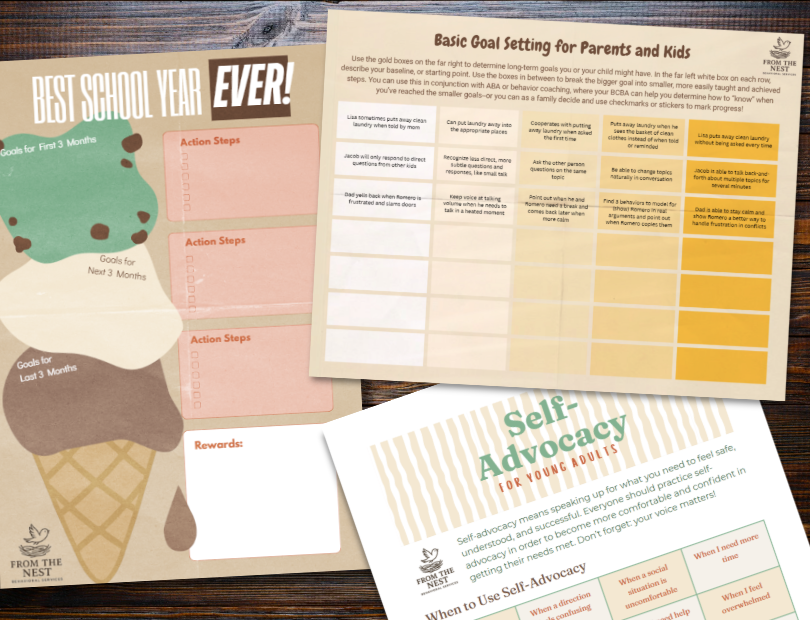
Look at our FREE Printable Resources page for routine visual supports, checklists, goal-setting worksheets, teen and young adult guides to jobs and self-advocacy, and more!