Building Routines That Actually Stick
My oldest didn’t sleep. She did, of course. But, for three years, she woke approximately every 30-60 minutes throughout every night. Without melatonin, she was awake until about midnight or 1 AM, then would wake between 4 and 6 AM. Then she was somehow still an engine at full steam, full throttle, ripping through the day until she finally just crashed. My husband and I were exhausted from “night shifts,” where one of us was on call, in and out of bed, mostly on autopilot, while the other actually got to rest. The pediatrician asked if we had a bedtime routine. I laughed.
I mean, sure. Everyone has a bedtime routine in the sense there is a nightly process. But if she meant to ask if we had some hour-long saga we followed meticulously each night with crossed fingers, praying it was the magic trick to getting this child to just stay in bed, who actually has the time or energy for that, especially when already running on half-empty? We had fallen off so many times and had seen such little success, no matter what we tried, that it just didn’t feel like anything we could do could make things better.
I have a feeling you can relate. Many parents can, in some way. Maybe it was or is also bedtime, or maybe the morning routine or homework or chores. Most routines don’t fail because the task wasn’t important, parents didn’t care enough, or parents didn’t try. They fail because the routine wasn’t built to match real life.
ABA can help, but not in a rigid, robotic way. The goal isn’t to force compliance—it’s to create a routine that’s doable, predictable, and supportive for your child and your household.
Here’s how to build a routine that actually sticks this time.
One Routine (Not Your Whole Life)
The biggest routine mistake is trying to fix everything at once. There may genuinely be multiple things that severely impact your or your child’s day, and there may even be multiple real health and safety needs. Start with one routine that will create the biggest relief:
- morning (getting out the door)
- bedtime (ending the day peacefully to set up tomorrow for success)
- after school (transition and decompression–and sometimes maintaining some household peace)
- homework time
- chores
Pick one for now. Not because the other routines don’t matter but because your brain and your child’s brain both need a win.
The Minimum Viable
If the routine requires perfect energy, perfect mood, and perfect timing, it won’t survive real life. Instead, build a routine that works even on hard days.
What’s the bare minimum we need to get done? What can be skipped without everything collapsing? What’s the “good enough” version?
For example, if focusing on bedtime, the minimum viable might be brush teeth (for hygiene), lay somewhere cozy and safe, and low stimulation (lights, sounds, and screens off). Things like pajamas, books, long chats, extra cleanup, and even climbing into bed versus a bean bag chair or a sleeping bag can wait for later, once the routine has been solid for awhile. But tonight, your child is clean, safe, and able to fall asleep.
A routine that meets the basic needs and works 100% of the time is better than an ideal routine that works maybe 50% of the time.
So What Was Step 3 Again?
It’s possible your child is ignoring you. But it’s also possible they’re losing the plot. Kids often struggle to hold a whole routine in working memory, especially when they’re tired, distracted, hungry, or dysregulated–all likely conditions when these routines like bedtime and mealtime come up–and especially when neurodivergent.
When we we use a visual, we can help keep them on task. Over time, we teach them to use the visual to stay on task themselves so they can manage independently.
For younger children, visuals might be picture cards or a picture step-by-step sign up in the area they will need it, like next to the mirror or the door. When my oldest was around 3 or 4, I started to even just doodle for her what I needed her to do or get, and she was excited to get to cross it off or erase it when each step was finished.
For older kids, teens, and young adults, a checklist, a dry erase board, a small pocket notebook they can keep with them, or even a note on a phone or tablet can come in handy. One teenaged learner I worked with really enjoyed flowcharts, even, as it “shook up” the routine based upon choice and how things happened. For example, a step might say, “Put away 1 basket of clean laundry or take the dog for a walk.” She would choose one, and that choice would lead to a new set of choices. If tomorrow she wanted to choose the other option, it would change the course of her chores for the day.
Keep things simple: First → Then → Then → Done. You may also choose to clearly label Step 1, Step 2, etc. For example:
- Bathroom
- Pajamas
- Teeth
- Bed
This reduces reminders, nagging, and conflict, and no one is surprised about exactly what is expected.
Put the Hard Part Earlier Than You Think
Often, routines break down at one specific step. Maybe your child is fine until it’s time to put the toys away, to turn off the tablet, or for their hair to be washed and rinsed.
Instead of saving the hard step for last, move it earlier and pair it with support. Putting the toys in the bin comes right before the bedtime story, not right before climbing into bed. Turning off the tablet happens at the same time as a race out the door to be the first one to the car. Hair is washed and rinsed first, then we toss in a colorful bath bomb and the plastic cars get a disco car wash (maybe that’s just our house).
Transitions are easier when they’re not abrupt and sad.
Reinforcement
If the only attention your child gets is during conflict, or if there’s a decent chance that crying, yelling, and fighting will wear mom or dad out enough they’ll give up, the routine will always feel like a battleground. Reinforcement doesn’t mean bribery. It means your child experiences the routine as successful.
Here’s some ways to reinforce:
- praise the effort (“you started right away”)
- celebrate the transition (“you handled that switch!”)
- use a simple point or token system
- end with something pleasant, like music, story, choice time, or even just some quality one-on-one time
Reinforce the behavior you want to see again.
Rome Wasn’t Build in a Day
If you’ve been stuck in a pattern for months (or years), it won’t change overnight. When a routine doesn’t work, the answer isn’t “we failed.” It’s “we learned something.”
Was the task or routine too long? Was the first step too hard? Was the transition too abrupt? Was the routine happening when my child was already depleted? Did I ask for too much at once?
Small changes create big results over time. Give it that time and be flexible, ready to adjust your approach if you see multiple, consistent instances of the current routine not working.
When to Seek Help
From the Nest Behavioral Services provides neurodiversity-affirming, in-home ABA therapy in the Boulder–Denver metro area (and surrounding communities), as well as virtual private pay behavior coaching. We and other ABA providers exist because this can be so challenging, and no parent or child should struggle through without support.
If you’d like help building routines that reduce stress and support your child’s independence, reach out to schedule an intake call or consultation, totally free and no obligation.
by Britt Bolton, founder & clinical director (BCBA)
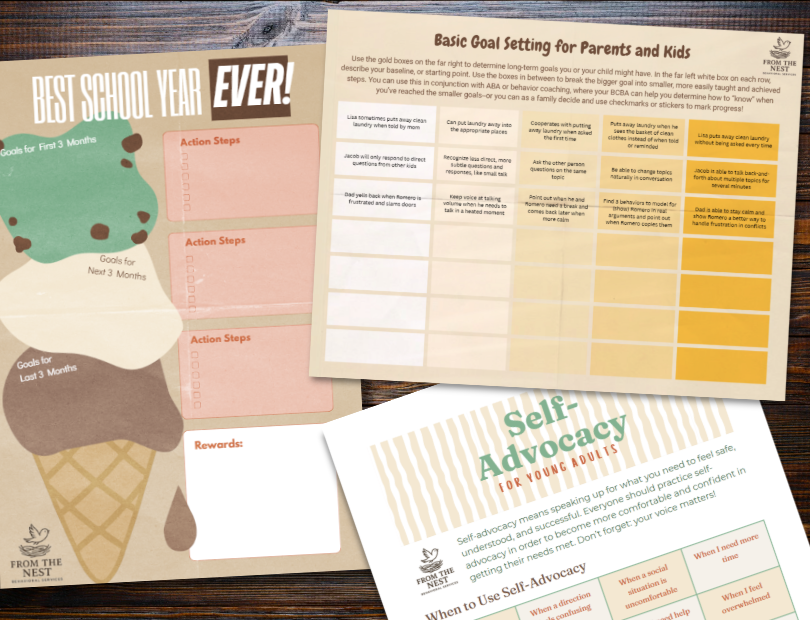
Look at our FREE Printable Resources page for routine visual supports, checklists, goal-setting worksheets, teen and young adult guides to jobs and self-advocacy, and more!