Is ABA Teaching Compliance?
Compliance. To be honest, when I entered the field in 2017, this was still the primary focus of training for RBTs and daily ABA sessions. You see it reflected in some of the online discourse on ABA therapy. Members of neurodivergent communities often have their own traumatic experiences with compliance training, including being forcibly restrained, being corrected and/or blocked from repetitive “autistic-looking” behaviors like hand-flapping, being forced to make eye contact, and being talked over when they expressed discomfort, unwillingness to do what was demanded, or other goals for themselves than what those around them prioritized. Compliance was getting learners to cooperate at, quite literally, any and all cost under the guise of treating their condition(s).
I would be outright lying to say compliance training is no longer a focus of ABA. The fundamental difference here in 2026 is that more and more providers are seeing the harm in blindly teaching and coercing learners to obey and are making strides to not only change their own practices, but make the field at large aware of and responsible for these necessary changes.
Compliance isn’t in itself a dirty word, and some families may have a hard time understanding the outcry. For some families, “compliance” sounds like a necessary part of safety, learning, and daily life. For others, compliance means ignoring feelings and autonomy, as well as prioritizing adult convenience over a child’s needs and self-expression.
So what does compliance actually mean in ABA, and where do ethics come in?
Some Useful Background
In its simplest form, compliance means following an instruction. This is what it meant when I went through RBT training and what many ABA professionals think of when they hear the term. Examples might include coming when called, stopping a dangerous behavior, participating in a task, and following classroom or household expectations. It’s easy to see how safety plays a role, as well as promoting learning and social opportunities. If a child was complying, it meant we could keep them and others from bodily harm and could keep making progress toward their treatment goals.
But here’s the problem: following directions is not the same as learning skills, and it’s definitely not the same as consent, cooperation, or understanding.
Many autistic adults and self-advocates have shared harmful experiences with ABA that focused heavily on compliance. These experiences often included:
- being required to obey without explanation (which, notably, clashes with actual teaching of skills and generalizing to other contexts)
- having communication attempts ignored
- being punished for self-regulation behaviors (like stimming)
- being taught to suppress discomfort rather than express it
At its worst, compliance-focused therapy can teach children that their “no” doesn’t matter, that adults always have authority over their bodies, and that discomfort should be tolerated rather than communicated. As much as ABA has historically focused on the safety risks of a child not complying with staying next to their adult or with asking for a toy instead of pushing a peer, for example, there is a clear imminent risk to learners when boundaries are blurred and adult authority is king. For populations that statistically are also highly impacted by speech delays and communication barriers, this risk is compounded by struggles to convey abuse and mistreatment to trusted caregivers.
Compliance, Cooperation, & Skill-Building
At our practice, we make an important distinction:
- Compliance = Doing something because someone else has power
- Cooperation = Doing something with understanding and support
- Skill-building = Gaining the tools needed to participate meaningfully
Our goal is never blind compliance. Our goal is to help children understand expectations; communicate needs, boundaries, and preferences; develop flexibility without sacrificing autonomy; and learn how to navigate real-world demands safely and confidently. Sometimes that means teaching when it’s important to follow directions, like safety rules. Sometimes it means teaching how to say no (what I frequently call “appropriate refusal”), ask for help, or request a break.
When Following Directions Does Matter
It’s also important to be honest: there are times when following adult directions is necessary. The ethical question is not whether children should ever follow directions.
The ethical question is how we teach those skills and at what cost.
Some of the things we ask as BCBAs are:
- Are we teaching and reinforcing understanding or just obedience? In other words, is the learner also directly or indirectly being taught the “why”?
- Is this expectation reasonable for this child’s developmental level and the environment?
- Have we taught the prerequisite skills?
- Is the child able to communicate discomfort or refusal?
- At what point are we seeing any hesitation or precursor behaviors (signals before distress, like furrowed brows, increased vocal volume, increased self-stimulation, etc.)? Can we change something about that point in the process, the materials, or other components to keep them comfortable while learning?
- How can we meet the learner where he or she is currently and very gradually, at the learner’s pace, build from there?
Ethical ABA & From the Nest
Ethical, modern ABA should prioritize:
Assent & Choice
Learners should have meaningful ways to indicate yes and no, request breaks, and express preferences.
Communication Over Control
Behavior is communication. Our job is to teach better communication, not silence it.
Reinforcement, Not Punishment
Skills are built through motivation, trust, and consistency. Not fear or force.
Respect for Neurodiversity
Not all behaviors need to be changed. Self-regulation, stimming, and differences in communication deserve respect.
Parent Collaboration
Families should also understand the “why” behind which strategies are used. They should feel empowered, not blamed or excluded.
It is okay to ask why a goal is important, if your child is allowed to say no or take breaks, and how a goal supports your child in the long-term.
We at From the Nest believe ABA should help children feel safe and understood. We prioritize building independence, developing self-advocacy, and helping a learner to participate in their world. I often describe to new staff that we are giving learners a tool box: there is no obligation to use the tools in the box, but they are available if they could come in handy in the future to access more of what is valuable to that learner.
by Britt Bolton, founder & clinical director (BCBA)
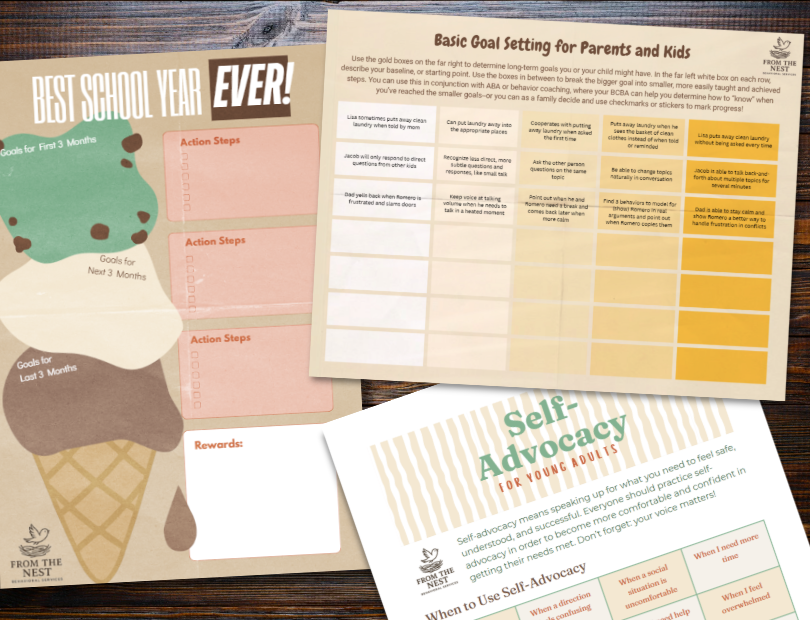
Look at our FREE Printable Resources page for routine visual supports, checklists, goal-setting worksheets, teen and young adult guides to jobs and self-advocacy, and more!