The RBT Experience, Part 3
Parents & other stakeholders
As we’ve already covered so far in the series, The RBT Experience, behavior technicians and their officially certified coworkers, RBTs, tend to really care for their learners and are excited to help them progress. If you aren’t someone who works in ABA, you may naturally wonder how they would describe their experiences working with parents, extended family and babysitters with active roles in learners’ lives, teachers, and more. After all, while BCBAs–their supervisors–handle the “real” parent training, or caregiver guidance, the BTs and RBTs are the ones coming into daily contact with these stakeholders. For BTs and RBTs who work in homes, schools, daycares, and community settings, stakeholders may be in ongoing contact with them, asking questions, looking for advice, challenging goals or teaching procedures, and more.
It may be unsurprising, then, to know that stakeholders can also positively or negatively influence learner success (how successful ABA itself appears to be for that learner) and RBT burnout.
In my rather lengthy list of “jumping off” questions during interviews with current and former technicians, I intentionally built in questions based on experiences working with parents, what technicians wish parents knew or understood about ABA and related areas, common family and teacher misconceptions about ABA, and what things seemed to make-or-break success in supporting and collaborating with a family. In my own firsthand experiences, I have experienced a wide spectrum of parent (I’m going to keep saying, “parent,” but sub in whatever stakeholder label you prefer) behaviors.
I’ve experienced abusive language from parents about and toward staff…and companies invalidate or trivialize it, try to guilt staff into continuing even when they felt unsafe, and ultimately permit such treatment for fear of reasonable boundaries resulting in clients pulling from services.
I have experienced parents clearly articulate that they opt out of caregiver guidance but then express frustration when they don’t understand the goals or aren’t seeing the same progress outside of sessions.
I have had parents who see and value a BT’s or BCBA’s care and contributions so much they have tried to give gifts (note: against the certifying board’s ethics code), fought against necessary restaffing, and even tried to delay “graduation” from services because it meant ending those relationships.
I could tell more (HIPAA-compliant) stories than I will probably ever have time for, all giving a useful glimpse into what the day-to-day is like and the vital role parents play in treatment. But that’s for another blog post or series.
For those I interviewed, parents also play an integral role, and sometimes undervalue their own contributions to learner success.
“It can be [discouraging as an RBT] when families don’t really have the buy-in to try to carry things over outside of session—for example, you come in and the PECS book or AAC device [communication methods] are in the same spot you left them in…It’s also hard when you know parents aren’t attending caregiver guidance. [meetings with the BCBA to develop their skills]”
A common concern from former and current BTs was lack of parent consistency outside of sessions.
In ABA, parent training, family guidance, caregiver guidance, parent support, and similar phrases all refer to scheduled trainings delivered by the BCBA, or master’s level case supervisor, to parents on the techniques being used to teach the child. While some parents may anticipate that bringing their child to an ABA center 40 hours per week or having someone come into the home or classroom to work with your child is sufficient enough to teach new skills, without consistency at home, the same skills may take longer to develop or may not be seen outside of those sessions with those specific ABA staff.
For example, I can think of two specific learners in my own experience who managed to toilet train in the ABA center but would still avoid the toilet or continue to void in their diaper, pullup, or underwear at home. In one case, when the parent was asked to collect data on how often they were taking the learner to the bathroom, was only taking them about once in the evening as opposed to the hourly trip originally agreed upon and, sometimes, not at all. In the other case, parents were stopping on the way home after therapy in the center to put the learner into a pullup, then keeping them in a pullup and continuing to change them with no prompts to the bathroom every evening and weekend. These kids were learning, even if unintentionally, that the bathroom was only for when they were in the ABA building and pullups, the more familiar and low-effort choice, were fine for everywhere else.
As one former RBT, put it, she wishes parents understood “that they also have to do the work at home, even if the RBT is great.” In other words, even if the ABA therapy team is top tier, you get out of the process what you put in. Another former RBT explained that the job becomes “difficult when [parents] think that therapy stops when they pick up” and has experienced parents who seemed “not willing to adjust anything at home.”
But don’t jump to thinking that technicians are insensitive to the challenges. As one pointed out, many parents are overwhelmed, may have other children in the home to care for, there may be multiple caregivers (and a mix of consistency and buy-in on ABA techniques), and other barriers. Another pointed out that the daily communication sheets provided by her company for technicians to fill out and give to parents at the end of each session didn’t adequately cover needed information.
In fact, she said, skills likely weren’t being trained thoroughly in parent training meetings with the BCBA–an assumption I can’t say I disagree with as a BCBA myself.
Interviewees seemed to agree across the board that the most progress was made and the best therapist-family relationships were established when families were open to seeing new approaches to working with their kids, even when they didn’t yet see immediate results, and even when it seemed counter to their own parenting or how they themselves had been parented as kids. Most of the RBTs agreed that they felt positively about family involvement when parents asked questions, though some expressed feeling overwhelmed when parents seemed to look for answers that should come straight from the supervising BCBA.
“With the family I work with now,” explained an RBT, “they have been supportive by working on things with my client even when I am not there [and] the progress and graphs of my client’s success speak for [themselves].”
“I wish that parents understood that…sometimes it looks intense while things are going on, and sometimes it can be easier to just give into behaviors, but you have to stay strong [and be consistent].”
As for misconceptions about ABA, a former RBT said, “I wish parents and the general public understood…that we want the best for our clients and their families. ABA works when the skills are being worked on by the family and the RBT as we are a team.” She continued, “The hardest part of the job is knowing that our field is often seen as babysitting instead of therapy.”
One former RBT, now a BCBA, shared this feeling: “A lot of people have a perception we just play with kids all day—daycare—or that [ABA is] inherently traumatic. A lot of people don’t realize that quality places focus on client assent and involve clients in identifying goals and teaching procedures.” She went on to say that ABA is “not a quick fix and doesn’t ‘fix’ autism. There’s nothing to fix.”
The way parents speak to and interact with RBTs speaks volumes to whether they are respected as professionals or seen as “the help.” Sometimes, disrespect comes in the form of attitudes or inappropriate remarks. Other times, RBTs are unfairly judged for plans put into place by their supervisors, challenging behaviors, client injuries even when safety measures are taken, and more.
“A family I worked with [in] a past clinic doubt[ed] what was being said about their child,” described an RBT. “When told that this child was aggressing towards peers and staff, they said, ‘not my child,’ and didn’t believe the data taken or the injuries I and others sustained.”
Regarding what might surprise a lot of stakeholders about ABA, a surprisingly common comment was on how so many techniques we use in ABA can be applied across kids and parenting situations. While some technicians who were parents during the job remarked that it was often exhausting to work through their own parenting challenges after a long, hard day, many then-parents or techs who have had children since moving out of the field described ways they use things they learned in ABA with their kids now.
As a BCBA who has had more parents than I can count on one hand ask how much of “this” I “really” use with my own kids–and a parent who regularly uses a lot of this with my own kids!–it is often funny to me how often people tend to forget or not understand that ABA, when used in an ethical, trauma-informed, neurodiversity-affirming, and otherwise “right” way, works because it follows the same behaviorism principles we all naturally follow. Not funny in some elitist, judgmental way, but funny in the sense that this has become such an engrained part of how I operate in day-to-day life, both inside and outside a session, that I probably need to better remember the experiences of those who don’t “live in” ABA. Only then can I properly explain, model, and teach ABA in a way that is accessible and makes a real difference in the lives of the families I work with. And I know I’m not alone in that reminder as a BCBA.
“Parents notice the growth. We see it, but seeing their lives change is exciting.“
So how do we continue to grow as supervisors? How do we in leadership–whether clinical or operational management–best support these direct care staff so that families continue to work with the quality technicians they deserve to have, high-quality RBTs continue to work in direct care and/or as future leaders themselves, and we are truly the kinds of companies we love to market ourselves as on social media?
Next time, let’s get into the good, the bad, and the ugly of the supervisee experience.
by Britt Bolton, BCBA
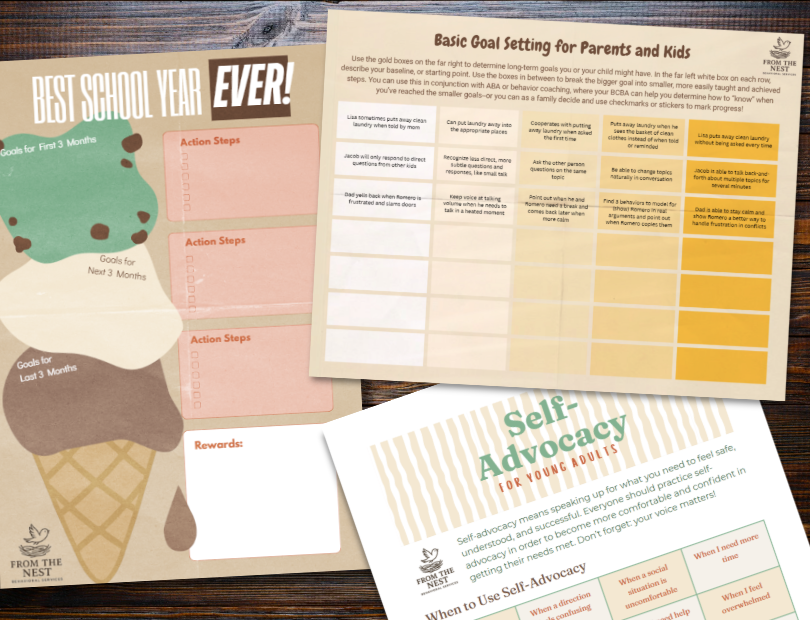
Look at our FREE Printable Resources page for routine visual supports, checklists, goal-setting worksheets, teen and young adult guides to jobs and self-advocacy, and more!