ABA in the Wild: How Parents Potty Train
How behaviorism techniques show up in day-to-day life
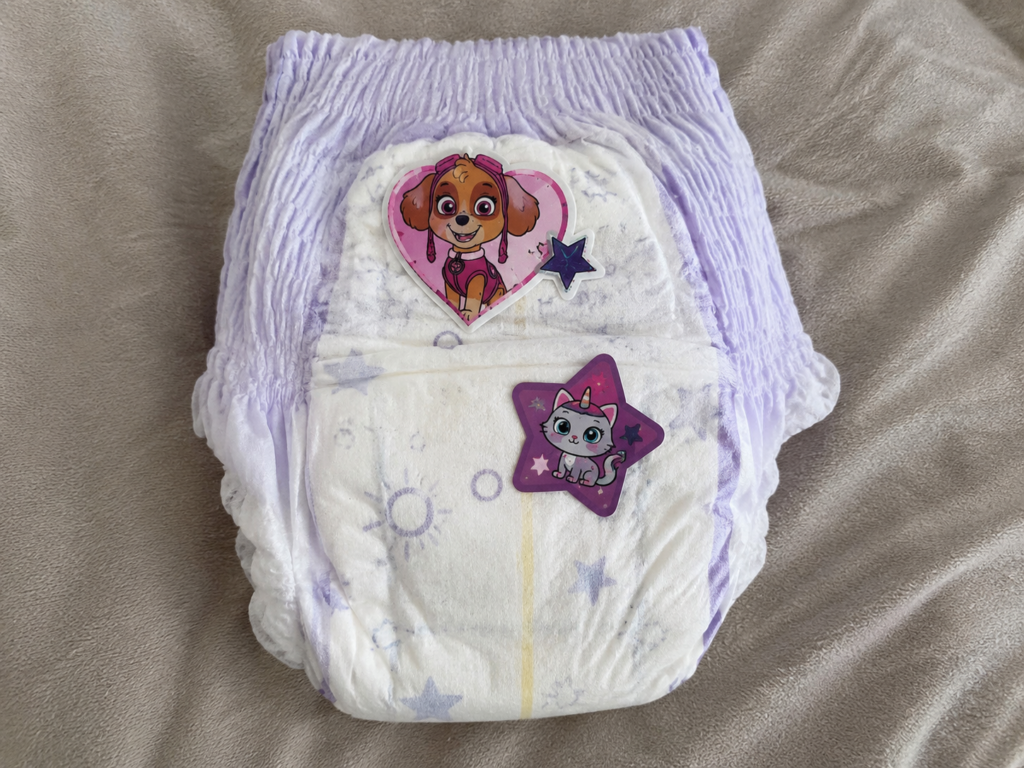
A content creator I follow on Facebook asked her followers for any tips and tricks they have on potty training. And boy did they deliver. From stickers to dry erase markers to princesses, from trash bags to timers to toilet water, there were the more routine suggestions and the truly creative!
What many don’t know, I’d wager, is that these systems all have roots in behaviorism principles–the sorts of things we use in ABA.
In fact, the reason your Facebook friend was able to toilet train her daughter with Skittles, your sister toilet trained your niece by just sticking her in undies without a diaper, and your son isn’t making much progress with either method has its root in behaviorism as well!
So let’s take a look at some of the comments I randomly pulled, still clustered as screenshots from my phone so you can trust (hopefully) that I’m not cheating somehow, with only the names censored. We’ll talk about the science behind the systems–and why individualized protocols are so necessary in ABA.

Red writes, “My daughter loved flushing. Her reward for peeing on the potty was she got to flush. If she didn’t pee, she wasn’t allowed to flush.” Sub in a favorite candy, a toy, a movie, a snack, or prize box, and you might recognize this quickly as your classic reward system. Go potty = get reward (in this case, flushing). In ABA, we call this the Premack Principle. We also see differential reinforcement, where the desired behavior (peeing in the potty) is rewarded while the undesired behavior (not peeing…if you know the Dead Man’s Test, ignore that for now, not important here) does not receive the reward. Notice that nothing is punished, and yet progress is still made.
Yellow’s advice was a bit different: “Put a trash bag under the sheet so when they wet the bed it won’t spoil the mattress…it showed [my daughter] how nasty it felt to sit in it.” Putting the trash bag, or any waterproof material like plastic wrap, a tarp, or a mattress protector, under the sheet is a great environmental modification! In this case, it helped to set up a natural punishment, or something that naturally follows a behaviors instead of being set up (contrived, like a timeout) to discourage reoccurrences of the behavior in the future. While we wouldn’t often go the route of punishment in ABA, especially regarding something that can cause health and sanitation issues, as well as be traumatic for the child and unethical, even this can be tied to the science of behaviorism.
Lime describes, “My twin girls caught on with blue toilet water. I showed them it turns green when you pee, they were all about it.” I love the ingenious behind this one! This would be more aligned with natural reinforcement. Like natural punishment, it’s something that naturally follows a behavior (unlike candy or stickers) because the act of peeing itself is changing the water. The great thing about this technique is that, as long as the toilet water remains naturally blue, no additional rewards are needed. You could possibly even have success with generalizing this to other environments by teaching how they can change the color of the clear toilet water in other places, or treating it like an “experiment” to see what color this new toilet at the toy store or at Grandma’s house or at McDonald’s changes. Hey, sometimes you gotta do it for the kids.
I love Aqua’s comment because it highlights a common misconception in ABA. They write, “We bribed with mini little M&Ms. 1 for #1 [urine] and 2 for #2 [feces].” Many parents, teachers, grandparents, and others we work with reference “bribing” learners. A bribe would be more akin to giving the candy in advance to try to convince them to engage in the behavior (voiding in the toilet). Think of mob bribes in the movies: the Big Boss pays the witness up front to convince him to not testify in court. Reinforcement, on the other hand, like we see here, occurs after the behavior. I also love that Aqua recognizes that bowel movements in the toilet can be harder for learners to master than urinating in the toilet and thus increases the magnitude of reward to better match the effort.

Blue writes, “Only thing that worked for my kid was she saw kids playing at a school playground snd [sic] said she wanted to play too. Told her she had to be potty trained for school and bam we were day time potty trained in a week.” This is a great example of setting clear expectations for accessing reinforcement. We can plan rewards all we want–the best rewards!–but if the learner doesn’t quite know how to earn them, they won’t drive progress.
Pink says, “We had our kids sit backwards on the toilet with a dry erase marker. Let them draw while going potty.” They also used candy as a reward after. But the drawing on the toilet is an exceptional example of stimulus-stimulus pairing. In pairing, you are literally pairing something preferred, like the drawing activity, with something neutral or non-preferred so that neutral/disliked thing becomes more liked. If you’re familiar with ABA, you may think, “Wait a minute… Pairing is when the RBT paired with my kid when they first started having therapy sessions together.” And you’re right! In that situation, the RBT (a neutral or even non-preferred “thing,” or stimulus) is paired with the things your child already enjoys so the RBT becomes associated with those pleasant things. On top of all of that, the drawing activity on the potty is a fine distraction to increase the kiddo’s tolerance for sitting, which can be soooo boring.
Olive adds, “Let your oldest get a piece of candy every time the youngest goes potty too…your oldest will take over.” In ABA, especially in classrooms, we might use something called a group contingency. There are three types. An independent group contingency means that everyone in the group has a fair chance at earning the reward, but only the members who meet criteria themselves get the reward. An interdependent group contingency is where everyone earns the reward only if everyone meets criteria. A dependent group contingency–what this appears to be–is where everyone’s access to the reward rides on one person’s (or a smaller subgroup’s) success. In other words, when the youngest child is successful, all the kids get candy. This can lead to the other children helping to motivate the “hero” along!

Purple, as part of a longer comment, writes, “I took the weekend off [and] we stayed home and I would ask them every 30 minutes.” While consistency is by no means unique to ABA, it is a huge, key part of it. I have worked with some parents who were frustrated their child wasn’t making progress, only to describe their routine of putting them on the potty as being once Monday, three times Tuesday, every 20 minutes on Wednesday, and zero times Thursday. When we put toileting interventions in place, we set something consistent so the child knows what to expect, all caregivers are on the same page, and we can balance more opportunities for success with also not overdoing to where the child is frustrated by or afraid of the routine.
Green goes a step further: “I started setting timers for every hour…She had to at least recite the ABCs [while sitting on the toilet]. If she didn’t go, the timer was set for 15 minutes until she went, then back to an hour.” You might think, “But that doesn’t sound consistent. The times keep changing!” Here, toileting is done every hour, creating a consistent hourly schedule. If the learner didn’t void in the time it took her to sing her ABCs, or about 15-30 seconds, she would be returned to try again every 15 minutes until she voided. This is still a consistent expectation. What’s unique here is that Green helps to avoid an accident between trips by shortening the time between trips. While it isn’t mentioned if this was the intent, the extra bathroom trips may also function as a mild punishment procedure, teaching the learner, “no void = increase interruptions to play time, sitting on a cold toilet, etc.”
Navy says, “We were told to let my son go…completely naked for a long weekend.” This is an antecedent strategy, where access to the item that leads to accidents–the diaper or pullup–is not present, helping to reduce the opportunities and typical contexts for accidents. We also remove the response effort required to successfully use the potty by already setting the kid up to just sit and “go.”
Again, these are just some example of “ABA in the wild”!
But why so many different ways, and why do the same ways that work for others not work for you and your child?
When BCBAs start to work with a learner on toilet training or any other skill, we look at a lot of different factors, but perhaps most importantly are the factors that currently seem to get in the way of progress (barriers) and what is motivating for the learner (reinforcement, or rewards). Barriers can be used to identify antecedent strategies and environmental modifications that can promote progress. For example, while your nephew was bothered by the coldness of the toilet seat on his bare bottom, and your cousin’s kid was fine pottying at home but couldn’t stand the unexpected flush of public toilets, your daughter may find the fluorescent lights in the bathroom too bright. As for reinforcement, while we recognize that receiving candy, a sticker, or something else every time you void isn’t practical, requires having those materials on hand at all times, and doesn’t age well for most kids, the goal is to start with a dense schedule of reinforcement, or very frequent access, and gradual thin toward fewer and fewer deliveries of reinforcers until either rewards are infrequent or are no longer needed at all.
The fact that people have success with so many different strategies just shows how invaluable individualized approaches to toilet training are. As you know well, every child is different. By working directly with a BCBA, who can learn more about what has worked and hasn’t, track patterns, and trial potential interventions with your unique child, you have a much better chance at finding success…and not needing a huge online or a late-night Google search to figure out what next to try.
by Britt Bolton, BCBA
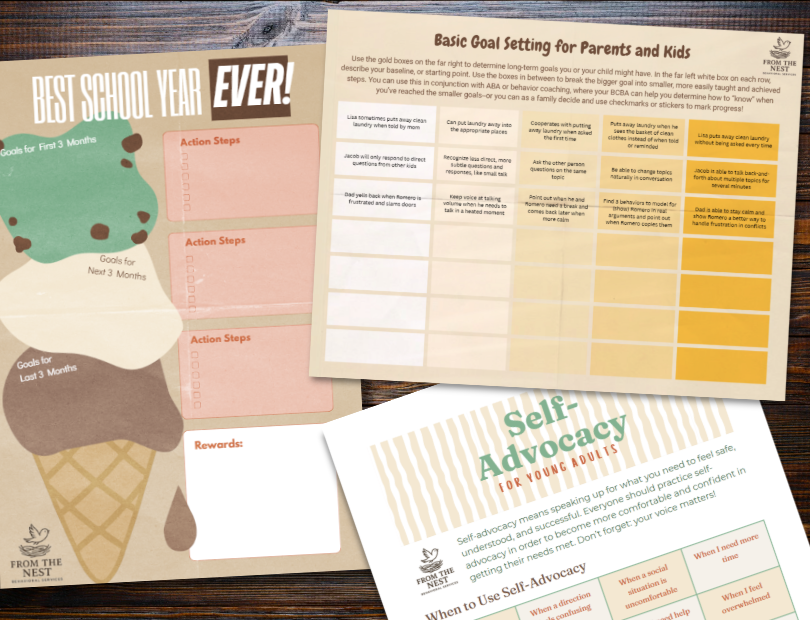
Look at our FREE Printable Resources page for routine visual supports, checklists, goal-setting worksheets, teen and young adult guides to jobs and self-advocacy, and more!