The RBT Experience, Part 5
Looking forward
Today, we wrap up the five-part series on The RBT Experience. No investigation into the experiences of real past and current behavior technicians would be complete without feedback company owners, management, and clinical supervisors can take with them. We all know that the more constructive and critical feedback is so easy to ignore, so I thought, “Let’s give them some of the highlights, at least, so they know what to keep doing.”
I can’t say it much better than my interviewees. They don’t need me summarizing and translating for them. So here is their direct guidance–insights straight from the direct support staff who see, hear, feel, and understand so much more than leadership tends to respect–and the things that keep them coming back (and it’s probably not what you think):
“[A moment that has stuck with me in a good way is] having run hundreds of trials to teach throwing the paper towel away during handwashing and my learner was finally independent!”
“At my current employer, I feel like they set me up for success by having monthly PDU (professional development) trainings, helping with furthering my education, acknowledging my skills, [and] meeting to check in monthly to help alleviate burnout and offer support.”
“My current employer listens, gives me ways to succeed, and proves they believe in me and my abilities. Not just through words, but through their actions. I am happy to say I love my job again.”
“When people who are not in the field, say things like, ‘I could never,’ ‘how do you put up with it,’ or ‘I would’ve quit already’…What these kids hear and feel is, ‘I’m not worth it,’ when they are worth the patience, love, kindness and more.”
“I do believe I did make a difference at my last clinic and with my new employer. I had a client who would elope a lot when I first started, and the amount of elopement decreased significantly [during] my time with that client. My client now was not speaking and now they are using full sentences to request things they want!”
“[A moment that has stuck with me in a good way is] starting a kid with limited skills and watching them blossom into a whole different child—a total 180 due to your dedication and consistency. Also developing strong rapport with some of the more challenging kiddos.”
“The best part of the job is the kids and watching them grow and finding their voice and being excited to do things on their own. Also seeing them ‘graduate,’ because people still sometimes think autism is a ‘death sentence,’ and it’s not…A lot of small victories equal big victories.”
“[Among the companies I’ve worked for,] I feel like they had their good things and their bad things, and if they could just combine or something, it’d be really great. Lack of breaks was a big deal-breaker.”
“I had another supervisor in the same clinic [as my bad supervisor] who actually played with and interacted with the kids, and she could be tough and give me direct criticism, but she also made sure to point out the good things I was doing and how I was improving. I would have left if not for her.”
“I don’t think owners always care. I think they need to care more in general. You have real-life people [to look out for] and have to help these families for the long term. Let’s not put brand-new RBTs on a high [intensity] child just for the sake of money and having a ‘body with a body’…that’s how injuries [to either party] happen…And I think owners choosing the right BCBAs, with the right history, is critical.”
“[A moment that has stuck with me in a good way is] seeing kids master new skills and how excited they would get.”
“I actually enjoyed toilet training because I was able to see how effective it was to use evidence-based, proven methods that I plan to use with my own kids because they actually worked. It was exciting and fun to figure out the most reinforcing and motivating things to build teaching into routines.”
“I felt giving new RBTs a chance to pair with different learners during training was very helpful because then leadership can see the RBT’s strengths, the RBT gets to learn more, and you can find an RBT-client pairing that actually works for both the RBT and the kid.”
“[Between two companies I’ve worked for,] the company that allowed RBTs the choice to leave if their client was out instead of substituting on another client was better than the company that just picked and chose who to send home or made RBTs sub-in on kids they didn’t know, who sometimes had really severe behaviors. Because that becomes not safe.”
“[I felt being supervised by a BCBA] went smoother with BCBAs with clear expectations. The BCBAs who were more lenient with some staff than others really impacted morale and everyone’s effort.”
“[I think] the center should have done a sort of open house night where parents could see firsthand what therapy in the center looks like. Daily parent notes didn’t really cover everything, and I doubt things were really being taught in parent training. At least they could see the therapy being done.”
“[Working in ABA is] rewarding—just rewarding in general. Hard, but rewarding.”
“I’ll always see the beauty in the kids I work with. No matter if it’s a good or bad day, we are working to show the world how amazing they are!”
by Britt Bolton, BCBA
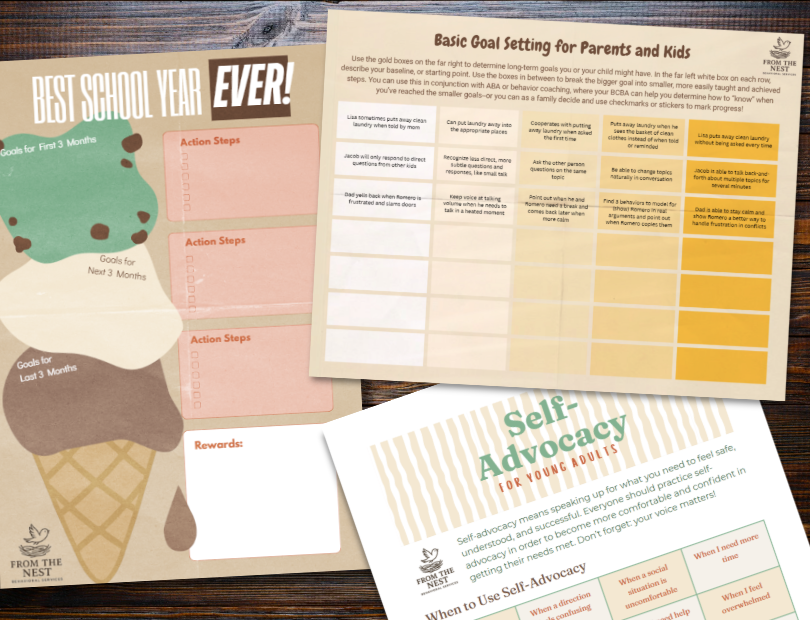
Look at our FREE Printable Resources page for routine visual supports, checklists, goal-setting worksheets, teen and young adult guides to jobs and self-advocacy, and more!