November 2025 Vocab of the Month: Behavior Momentum
The bowling ball hits the smooth wooden floor. It spins toward the ivory pins at the end of the lane, staying mostly straight in its path until it crashes into the single pin in front. In a matter of seconds, a ball left the bowler’s hand, shot toward its goal, and sent pins flying.
Science–physics–would probably look at the bowling ball’s momentum, or how hard it would be to stop the motion of the ball. Because that ball is heavy and is propelled forward with force, it has more momentum than a beach ball or a bowling ball lightly tapped forward by the end of someone’s shoe.
Behavior momentum can be conceptualized in a similar way. When we are strategic, we can increase learner motivation and likelihood of completing a task thoroughly and correctly while reducing frustration. Behavior momentum is the concept that we can propel behavior forward, so to speak, toward a goal by using reinforcement as a force.
In ABA, we start with high probability tasks, or things the learner is likely to do. If a session begins with the BT/RBT pairing themselves with preferred items and activities, as the session should, the BT/RBT can then begin to introduce instructions that the learner is motivated and likely to cooperate with. From there, task demands–the somewhat blunt or harsh term we have for instructions or requirements–can become gradually more low probability, or the tasks the learner maybe wouldn’t otherwise cooperate with without behavior momentum. Note that it is never the intention for ABA staff to “make” a learner do things they find upsetting, and this is not a way of tricking them. Instead, if there are tasks that may be more triggering for a learner but still necessary, starting with high probability tasks gives opportunities to reinforce cooperation and build up to the things that might be more upsetting outright.
Let’s look at two scenarios, both involving RBT Keisha trying to get learner Patrick to pause their game to go to the bathroom. In her session with Patrick, Keisha forgets all about behavior momentum. She puts the dice in her pocket and says, “Okay, we gotta take a break and go potty.” Patrick cries, swipes the game onto the floor, and lays across the floor to avoid going. Keisha feels flustered–she’s supposed to have Patrick try to go to the bathroom every hour so he doesn’t risk an accident, and now he’s refusing to go.
In the next session, Keisha feels more prepared. They still start out with their game but, about 10 minutes before Patrick needs to go to the bathroom, she asks, “Hey Patrick, can you move my piece for me?” Patrick loves to count the spaces, so he readily moves Keisha’s piece. She smiles and says, “Wow, what a big helper! Thank you for moving my piece!” A couple minutes later, Keisha says, “I’m getting antsy. It’s hard sitting here for a long time. Will you do a few stretches with me?” Patrick hops up and does a few yoga poses with Keisha next to the game. Before he sits down, Keisha says, “Great stretches! I still have a lot of energy. You wanna race with me before we finish this?” Patrick races with Keisha a couple of times back and forth across the house, finally winding up just outside the bathroom. Keisha says, “Oh! Let’s do potty super quick while we’re here before we go back so we don’t interrupt our game!” Patrick says, “Good idea,” and he goes into the bathroom.
Why did this work? First, Keisha praised Patrick’s cooperation even with brief tasks, which helps to motivate him to continue to respond appropriately. Second, Keisha used highly probable tasks, like moving her game piece and stretching next to the game, before introducing something less probable. Third, Keisha built the more triggering task of taking a moment to potty into the routine in a way that was consistent with Patrick’s goal of getting back to/accessing the game.
So what do you do if the learner refuses what was supposed to be a high probability task? Refusal can mean one or more of the following: The task you thought was highly probable actually wasn’t, at least not this time; Motivation to cooperate is lower than motivation to not (like Patrick’s motivation to keep accessing the game); The task or environment is aversive, or there is something about it the learner is avoiding; The learner isn’t ready for demands.
If this is the case, don’t push it and get into a power struggle, especially over a small ask! First, pause. Continue to pair and help the learner to be happy, relaxed, and engaged while evaluating what could be the issue. Next, attempt something even more probable, like asking the learner to get themselves a piece of candy, asking for a high-5, or asking them to take an extra turn in the game–something they will almost definitely not turn down. If they’re resistant even to this, there is a good chance the learner is not happy, relaxed, or engaged. They may be hungry, tired, overwhelmed, coping with illness or a medication change, or another barrier. If you can help to identify what’s wrong and relieve it, absolutely try to–but note that any actual or perceived demands may continue to be a struggle.
In this kind of situation, if Patrick was having a generally rough day or session, I would recommend that the RBT modify the procedure slightly to promote and respect client autonomy and to help, not hurt, the trust and rapport between the RBT and the learner. Keisha could offer a bathroom break to Patrick every hour instead, could see if having the parent instruct a bathroom break is any more successful, offer a bigger reward for every bathroom break he takes that session, or even try taking a bathroom break herself before then encouraging Patrick to do the same. Whether Patrick is responsive to and successful with one of these adaptations or has an accident (undesired response) without the consistency of the intervention of having him access the toilet hourly, we have more data to inform our interventions and how to approach the skill moving forward.
by Britt Bolton, owner/lead BCBA
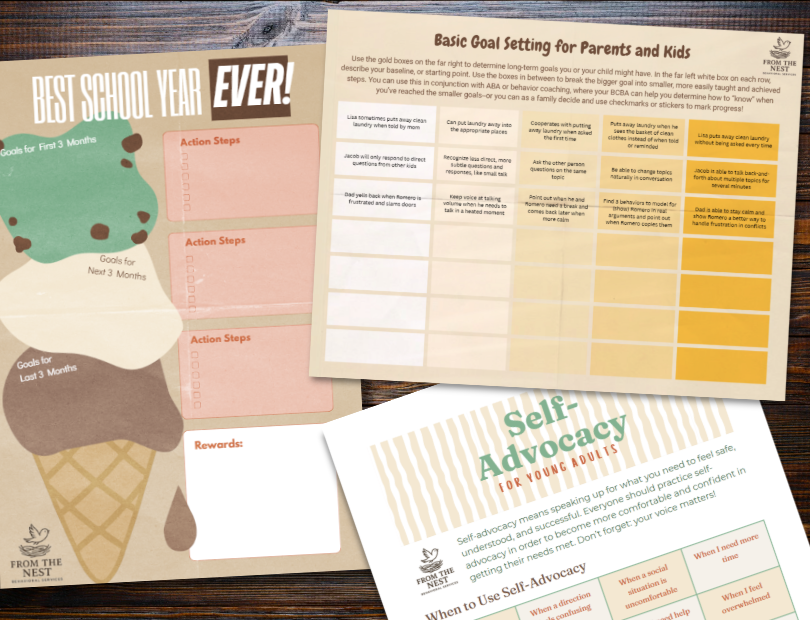
Look at our FREE Printable Resources page for routine visual supports, checklists, goal-setting worksheets, teen and young adult guides to jobs and self-advocacy, and more!