When Big Feelings Take Over: All About Co-Regulation
I think many of us are familiar with self-regulation. This is our ability to process, or regulate, our individual emotions, body, and behavior. But how familiar are you with the concept of co-regulation? This is the process where an adult helps a child to regulate–the trick is, it requires some self-regulatory skills in the adult, as well as the ability to model consistently even when another person they care about is escalated.
This is yet another place where parents are responsible for guiding their children who are not born with inherent self-regulation skills, but have to learn healthy ones. It’s not regulating for them; it’s doing it with them.
“What It Is and Why It Matters”
This video from the Administration for Children and Families (ACF) says (and shows) things in an even better way than I can. I highly, highly recommend giving it a watch, though I’ll also be touching on some of this below.
Kids learn regulation through repeated cycles of dysregulation, support, calming, and reflection. Their brains internalize these patterns through practice. Neural pathways strengthen with every regulated interaction. It really is the old adage “practice makes perfect.”
Self-regulation is a skill that matures over time, not something a child simply decides to do. The alternative is growing into an adult who cannot handle frustration or upset, who struggles with relationships with others due to being unable to navigate conflict, who shuts down or lashes out at the smallest problem or inconvenience, and who sometimes even adopts unhealthy habits as coping mechanisms. Kids who receive consistent co-regulation, however, develop better emotional awareness, increased frustration tolerance, improved problem-solving, safer relationships, and stronger executive functioning.
Not Just For Kids
“A regulated, calm adult can regulate a dysregulated child but a dysregulated adult can never calm a dysregulated child.” – Dr. Bruce Perry, American psychiatrist
As described above, self-regulation skills are important for adults just as much as for kids, and being able to self-regulate as a parent–even when your child is pushing your buttons–means keeping your own stress manageable. It is completely normal to feel overwhelm. As a parent myself, I cannot stress this enough. Dysregulation happens, even with the most emotionally intelligent person! Climbing back up on the horse is more important than a perfect ride.
Here are some strategies for parents to self-regulate before attempting to co-regulate with their children:
Pause Before Responding
As long as everyone is safe, you do not have to respond right away, even when things feel dire. It is perfectly fine to say, “I’m going to take a breath so I can help you better,” or even to step out for a minute while a co-parent or another family member helps, if possible.
Use a Grounding Technique
Use deep breaths, the 5 senses check-in, stretching, or another technique you have found helps you to calm down. If you’re not sure, think about what you use when things become stressful at work, when you become frustrated in the store checkout, or when in a disagreement with a friend.
Identify Personal Triggers
If you know what things really push your buttons, including with you kids, you can better plan for and anticipate them.
Self-Compassion
This might be the hardest part for some parents. Treat yourself with patience and kindness. I know for myself, if I view a situation objectively, as if happening to a friend of mine, I realize that I am being more self-critical than I would ever be of someone else.
Consider how you felt the last time your child screamed and threw themselves to the ground in the store or at a party. You probably felt embarrassed, nervous how others would act or for what they would say, and like you weren’t being a very good or capable parent. But now consider how you felt the last time you say another family in the same shoes. I’m guessing you thought something about how hard that can be, wondered if you should offer some help, or realized how rude the judgment of some others in the area was. Show the same care and sensitivity to yourself.
Real-Life Application
In co-regulation, parents model for their children the following:
- Responding instead of reacting
- Consistent boundaries
- Emotional balance
- Protecting their own mental health
- Preventing burnout
That’s a fine and nice mentalistic explanation, but how can we put this into objective, measurable behaviors that we can tackle through ABA therapy, parent training, and behavior coaching? You know–things you can actually put into practice at home, right now.
Try the following, even outside of big behaviors, to start getting into healthier co-regulation habits:
| Connection Before Correction | ⟡ Prioritize the relationship moment over the behavior ⟡ Get down on the child’s level and use a neutral voice, even when you’re trying to not explode ⟡ Stay close without demanding engagement/interaction. Even silent presence communicates safety. |
| Tune In | ⟡ Put words to their feelings and body language: “I see your body is really fast right now” “This is really frustrating for you” ⟡ If they are hot, overstimulated, uncomfortable, hungry, etc., they’re going to have a hard time regulating. Offer a squeeze, a hug, a drink of water, taking breaths with you, or other soothing and regulating techniques–offer, do not force or obligate them to accept. ⟡ Note that providing comfort and help is not reinforcing an undesired behavior. Even if a tantrum occurred to access a snack, for example, we are modeling that calm is gaining us access, and the research shows that, once the child is escalated, the brain is no longer as open to learning–the opportunity for teaching the more appropriate access behavior was before they were thoroughly distressed. This does not mean that teaching is useless or that you did something wrong as a parent–it means that we can teach later and that now is the time for repairing the connection and helping the child return to a state of happy, relaxed, and engaged. |
| Lead Through Language | ⟡ Use simple, regulating phrases: “You’re safe. I’m here.” “We can handle this together.” “Let’s take one slow breath.” Again–do not push. If your child starts to re-escalate, return to being a quiet, calm presence. You might try again in a few minutes. ⟡ As they become more receptive to guidance, organize the solution or expectations into simple steps so it isn’t as overwhelming and creates predictability and stability: “First, we breathe. Then, we clean up one block at a time.” |
| Behavior-Specific Praise | ⟡ Point out progress, or desired behaviors, even small ones: “Great job with those deep breaths! I love that you’re taking a moment of quiet.” ⟡ Be specific with what you want to continue to see. Phrases like “good job” or “awesome” can be used but can be vague and harder for the child to recall in future situations |
| Offer Choices | ⟡ All some flexibility with the things that are less necessary, like which materials, where to complete it, etc. When kids have some control, they are more likely to cooperate with the important steps that cannot be left to choice. “Do you want to hold onto the shopping cart or hold my hand?” —-> more cooperation walking next to you ⟡ When presenting choices, don’t just start listing things (“we could draw, take a walk, watch a video,…have a snack,…play a game…”). Instead, present just 2 choices to limited overwhelm and decision paralysis, or the child not being able to choose. |
| Repair As Needed | ⟡ Own your own struggles to regulate. This doesn’t show weakness–it builds a trusting and honest relationship and justifies that self-regulation can be tough for everyone. “I got overwhelmed. I’m sorry I yelled. Let’s try again together.” ⟡ This also creates kids who empathize and apologize when they break rules and hurt others physically or emotionally, as well as kids who take accountability for their mistakes. |
Strategies That Grow With Them
You may have in your mind younger children as we talk about co-regulation, but preteens, teens, and young adults also need this sometimes. In fact, the brain changes, hormones, changes in social pressures, and more can make this even more challenging and necessary, as we touch on a little bit in the blog post Early Learners Grow: Motivating and Supporting Teens (23 November 2025). Teens may benefit more from the following:
- More Space: Preteens, teens, and adults may storm off to their rooms, cover their ears, take over you, or yell at you to leave them alone. You can still show calm presence by avoiding back-and-forth negotiating or arguing, staying in the same nearby location when possible, and letting them know that they can come talk to you if or when they feel ready. You don’t have to accept disrespect, and it is invaluable to also build prosocial conflict resolution and problem-solving skills–but when they’re dysregulated isn’t that time. You will have more success in having a productive conversation with them after if you are a safe and non-judgmental space for them than if they are afraid of punishment, belittling, or condescension.
- Gentle Structure: Instead of telling an older child or adult what to do or what they “should” do, approach guidance as a mutually respectful conversation. If you have ever managed or supervised staff, you will probably recognize that you can still have influence without being aggressive, taking away the other person’s choice or autonomy, coercing, threatening, yelling, or giving ultimatums. As described above, you want to be the mentor your child seeks out, not hides things from or feels like they should avoid to maintain their peace. Some parents will argue that they aren’t supposed to be their child’s friend, and that’s true–but friends are not the only people in our lives who should show us grace and support.
- Point Out Positives: We still want to use behavior-specific praise when our older kids makes steps of progress. While for younger children this can be primarily important in helping them to learn, for older kids, this can mostly be to avoid them feeling that their efforts aren’t even noticed and thus aren’t worth improving. Even if it’s something they “should” be doing, like not slamming the door or speaking in a respectful tone, saying something like, “Hey, I noticed you didn’t slam the door when you were frustrated earlier–I really appreciate that” or “it really helps me to also stay calm when you respond to me in a regular speaking voice instead of yelling” can show your preteen, teen, or adult child that you recognize that growth is occurring and isn’t instantaneous.
Whole Family Practice
Co-regulation is not coddling. It’s not permissive parenting, and it’s not giving in. It’s a necessary process in raising truly healthy, independent, happy kids. When you regulate yourself and stay connected during your child’s hardest moments, you’re building their brain, their confidence, and your relationship–one moment at a time. Model the behaviors you want to see and be ready to access the small steps of progress from you child and from yourself. You’ll be a few steps closer than you were yesterday.
by Britt Bolton, owner/lead BCBA
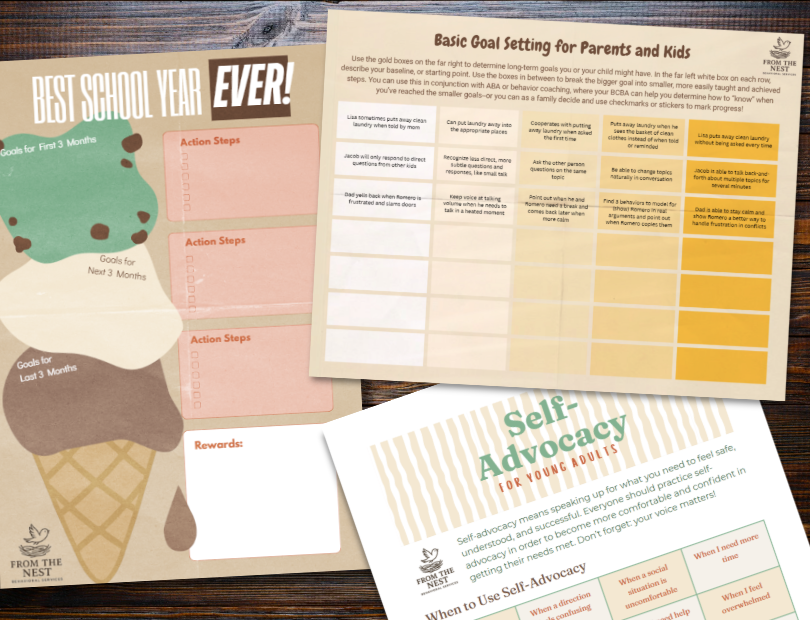
Look at our FREE Printable Resources page for routine visual supports, checklists, goal-setting worksheets, teen and young adult guides to jobs and self-advocacy, and more!