Is Reinforcement Bribery?
If you’ve ever caught yourself saying something like: “Please stop crying and I’ll give you a cookie”…and then immediately thought, Wait. Am I bribing my child? You’re not alone.
One of the most common questions parents ask when they first learn about ABA is whether reinforcement is basically just bribery with a different name. It’s a fair question.
On the surface, they can look similar. Both involve giving something a child wants, but in practice, they are very different. Understanding the difference can completely change how you approach behavior at home.
The Key Difference: Timing
The easiest way to understand reinforcement versus bribery is to look at when the reward is offered.
Reinforcement happens after a behavior and is planned ahead of time. Bribery usually happens during a challenging moment when we are trying to make something stop.
Here’s a simple comparison.
Reinforcement might sound like this: First finish your homework. Then you can have 10 minutes on the iPad.
Bribery tends to sound more like this: Please stop screaming and I’ll give you my phone.
In the first example, the child knows the expectation ahead of time. They complete the task, and then something positive follows.
In the second example, the reward appears in the middle of a problem behavior. Over time, this can accidentally teach the child that the behavior is a way to get what they want.
Reinforcement Is How Everyone Learns
Sometimes reinforcement gets a bad reputation because it’s associated with “rewards.” But reinforcement isn’t an ABA trick. It’s actually how human behavior works across the board. Adults experience reinforcement constantly.
We go to work because we receive a paycheck. We exercise because we like the results. We call a friend because we enjoy the connection. Those outcomes make us more likely to repeat the behavior. Children are no different.
When we use reinforcement intentionally, we are simply helping them connect their actions with positive outcomes. That connection builds learning, confidence, and motivation.
A Simple Strategy Parents Can Use
One of the easiest ways to use reinforcement at home is the First Then approach.
If you’ve worked with an ABA provider, you may have seen a First Then board before. But you don’t actually need a board to use the strategy. It can happen naturally in everyday moments. The idea is simple.
How to Use First Then
First comes the expectation. Then comes the reinforcement.
Examples
First clean up your toys. Then we can go outside.
First put your shoes on. Then you can choose the music in the car.
First finish your worksheet. Then we can play a game
The beauty of First Then is that it gives children clarity. They know what is expected and what happens next. Instead of guessing or negotiating, they can see the path from effort to reward, and that predictability helps behavior improve over time.
Common Moments Parents Accidentally Use Bribery
Even when parents understand the difference, real life can still make things tricky. Most bribery happens in stressful, public, or rushed moments. We’re tired. The child is overwhelmed. We just need the situation to end.
Some very normal examples include:
At the Grocery Store:
A child begins to cry in the checkout line. A parent quickly offers candy to stop the meltdown.
Leaving the Park:
A child refuses to leave. The parent offers ice cream if they stop protesting.
Getting into the Car:
A child resists the car seat, and the parent offers a phone or snack in the middle of the struggle.
None of these moments make someone a bad parent. They are incredibly common, but if the reward always appears after the problem behavior begins, the child may start to learn that those behaviors are effective.
Shifting the timing makes a big difference.
For example:
Before Leaving the Park:
First we walk to the car. Then you can pick the music.
Before Entering the Store:
First we stay with the cart. Then you can choose a snack.
Now the reinforcement supports the behavior you want to see instead of accidentally rewarding the behavior you are trying to reduce.
But Shouldn’t Kids Just Listen?
This is another question that comes up often.
Many parents worry that using reinforcement will make children dependent on rewards. They picture needing to hand out prizes forever.
That’s not how reinforcement works in practice.
In ABA, reinforcement is often gradually faded as a skill becomes more natural.
A child may first earn a sticker for cleaning up toys. Later, the routine itself becomes enough. Eventually the reinforcement might simply be praise or the natural benefit of having a clean play space.
Reinforcement acts like training wheels. It supports learning early on, but it doesn’t stay forever.
The Bottom Line
Reinforcement is not bribery. Bribery tries to stop a behavior in the moment. Reinforcement teaches a behavior we want to see more often.
When expectations are clear and reinforcement follows success, children begin to understand how their actions lead to positive outcomes. That understanding builds independence, communication, and confidence.
And at the end of the day, that’s the goal. Helping children develop skills that make daily life easier for them and for the people who care for them.
By Olyvia Block, Clincial Education Coordinator
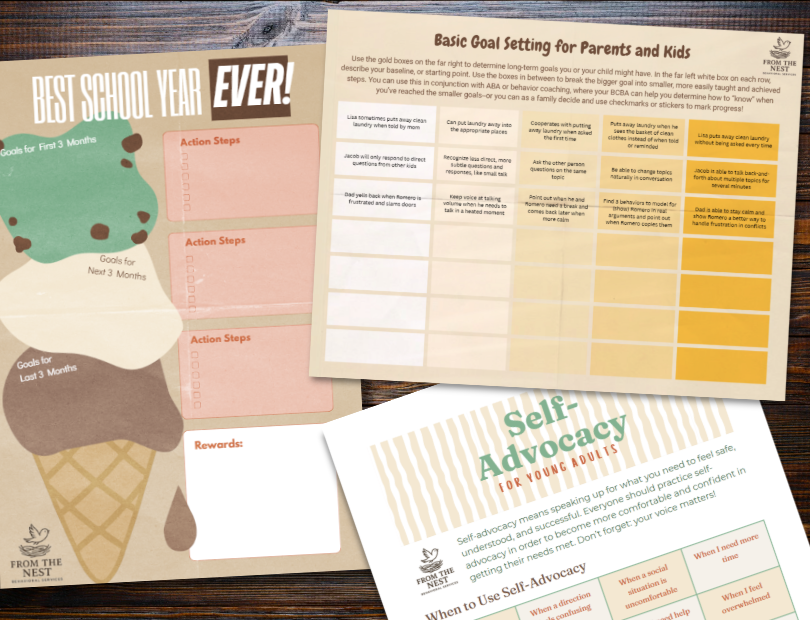
Look at our FREE Printable Resources page for routine visual supports, checklists, goal-setting worksheets, teen and young adult guides to jobs and self-advocacy, and more!