“Stop Fighting With Your Sister!”
If you’ve said it once, you’ve said it a million times.
“Leave your brother alone.”
“Can’t you two get along?”
“Hey! Play nice!”
“Stop fighting with your sister!”
Yet the fights keep happening anyway.
Sibling conflict is one of the most exhausting parts of parenting. It’s loud, it feels urgent, and it can make you feel like you’re constantly “on duty” as referee. And when you’re already tired, overwhelmed, or trying to get dinner on the table, it can push you past your limit fast.
There’s good news: sibling fighting is not a “bad kid” problem. It’s usually a “skills plus environment” problem. “Environment” doesn’t mean a chaotic home, bad parents, or poor structure–it means that the behaviors can improve with the right external supports in place.
This post will walk you through practical, neurodiversity-affirming strategies to reduce sibling conflict and teach real-life skills your kids can actually use.
The Real Goal
First, we have to have the right mindset. The real, reasonable, achievable goal isn’t “my kids never fight.” Kids fight verbally and physically with other children, especially siblings, as part of early childhood development while they develop the communication, emotional regulation, self-advocacy, perspective-taking, and other social skills we often take for granted as adults. With siblings, more opportunities are present, and at times things like shared space/proximity, shared interests and toys, variable parent attention, and other motivators can lead to fights that wouldn’t necessarily occur with classmates or kids at the park. Like tantrums in young children, what we might find overreactive at times or disruptive is a child figuring out how to get their needs met effectively while still learning what it typically consider socially appropriate.
A realistic goal instead is:
- seeing fewer fights overall
- seeing less intense fights
- kids recovering individually and restoring the relationship faster after conflict
- increased independence in solving small problems
- kids using safer behaviors–without an adult referee–when emotions run high
In other words, we’re not aiming to create perfect harmony. We’re trying to create a home where conflict is manageable and kids continue to build skills over time rather than stagnate or regress.
Proactive, Not Just Reactive
Most families try to handle sibling conflict only once it’s happening. But the biggest improvements usually come from prevention: setting up the environment so fights happen less often in the first place.
Here are a three of the highest-impact changes:
Establish Protected Items
Each child gets a small set of items that are not shareable. No one has to ask, negotiate, or defend them. This reduces constant power struggles or someone always having to adjust or give up something for someone else to keep the peace. Expectations are clear.
Sharing is Optional (Sometimes)
Sharing is a great skill… but forced sharing can backfire, especially for younger kids. Instead, teach asking first, taking equal turns, trading items, and choosing a different activity when the other person sets a boundary. Hint: This also helps set kids up for success in recognizing their own boundaries and others’ consent as they get older.
If you want to practice sharing, start with something neutral or not super highly motivating for either child. For example, you might draw their attention to a cool pinecone while out for a walk and model how you take a turn to hold it, then brother takes a turn, then sister. Be sure to draw positive, specific attention to appropriate waiting for their turn and willingness to give the next person a turn. If needed, be the buffer–have the first child hand off to you to then hand off to the other child.
Build in “Separate Time”
Like some friends and even couples, some siblings genuinely do better when they aren’t together all day, no matter how much they care about each other. Try 15-minute separate activities every couple of hours on particularly tense days.
A system we use in our house for our currently 8-year-old and 4-year-old is that the older child gets evening “self-care time” of her choosing (a bath, reading, music through headphones, whatever helps her to decompress) while the 4-year-old gets one-on-one quality parent time, then the 8-year-old gets her quality time after her little brother goes to bed. Our almost-preteen gets to practice listening to her body’s needs and emotionally regulating, our preschooler gets the parent attention he craves, and both kids get a little break from each other so they’re calmer and happier when they come back together for playtime.
Teach While Calm
When kids are already yelling, crying, or hitting, it’s not the best time to teach. The goal is to teach skills ahead of time, so they’re available when things get hard.
Break or Space Requests: Teach your kids both how to communicate when they need left alone and how to respond without getting escalated, like by saying okay and walking away or choosing another activity.
Trade and Turns: Instead of grabbing, teach kids to ask to trade items or to ask for a turn. Teach how to respect whichever answer–to say thank you if the person accepts and to find another option if the person says no.
Repairing: A lot of parent prompt kids to apologize after the fact. Consider also teaching how to name what went wrong and what they’ll do in the future: “I’m sorry I threw your doll. Next time, I’ll ask you to play quieter or I’ll move somewhere else.”
Live Fight
Okay, so they’re already fighting.
Safety first, coaching second.
Remain calm, even when it’s difficult. Big reactions can accidentally reinforce the fighting because it becomes a reliable way to get intense attention, plus kids learn that Mom or Dad will come save the day. Give a short, direct instruction, like “Separate,” in a firm but neutral voice.
If they’re escalated, don’t force a “talk it out” moment. Just create space. You can send kids to different rooms, opposite sides of the couch, or have one child with you and the other with another adult if possible. The aim is not punishment but containment.
Coach one small, doable skill. Don’t lecture. Don’t put anyone on trial. Direct to ask for a turn, model a self-advocacy request like “stop it” or “I don’t like that,” or practice a skill before returning to sibling.
Don’t accidentally reward behavior you’re not fine with continuing in the future. If one child hits and gets the toy, and you leave it with them “to keep the peace,” you may accidentally teach that aggression works. Instead, remove the item temporarily and walk the child through how to appropriately ask for a turn. If this further escalates the situation, it may be time to reset the situation by leaving the triggering item out of the equation until everyone is calm again, then practicing later.
When Sibling Fights are severe, long, or all the time
Sibling conflict is common but sometimes it crosses into “we need support.”
If you’re seeing severe safety risks (hitting, biting, damaged property, weapons, threats of harm, injuries), one child consistently targeted or fearful, fights getting worse instead of better, a child who cannot easily recover once activated, or anyone in the family feeling constantly overwhelmed or unsafe, it’s time to get help.
Support can look like parent coaching, behavior consultation, safety planning, and skills training for emotional regulation and communication. We are always more than happy at From the Nest to give a free, no-obligation consultation, where we can help to determine if we’re the right fit or we can recommend another resource. Complete our contact form below (or on our homepage) to get in touch!
by Britt Bolton, founder & clinical director (BCBA)
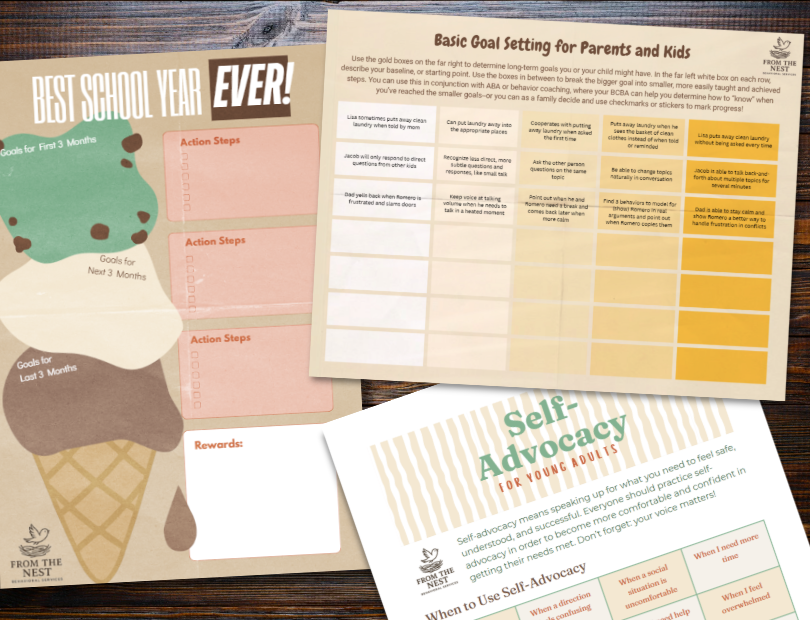
Look at our FREE Printable Resources page for routine visual supports, checklists, goal-setting worksheets, teen and young adult guides to jobs and self-advocacy, and more!