The RBT Experience, Part 1
Welcome to ABA
I knew nothing about ABA when I was contacted by a recruiter for one of the biggest providers in the country. After a BA in English and having applied to 30 entry-level jobs already without so much as a form rejection, let alone an interview, I had finally just uploaded my resume to Indeed. Before the interview, I had done my research, and I already knew that I wanted to one day be a BCBA.
My story’s not an uncommon one. Across my first batch of RBT interviewees, I was unsurprised to find, for example, a paraprofessional, group home support, a CNA, a recent college grad, a mental health therapist–education- and healthcare-adjacent hardworkers with limited exposure, if any, to autism. One interviewee said that, having worked with adults with autism, she still didn’t realize just how differently kids on the spectrum could present until she entered the field. Many heard about ABA from someone they knew or a job posting online.
“I expected the job to be like a teaching job in some capacity as ABA was something I had not heard of when I started. I was surprised by how hands-on it was and all of the terminology.”
“I thought it was more like hanging out with the kids,” explained one former RBT of what prompted her to pursue the job. She said there had really been no mention of “behaviors”–things like hitting, biting, throwing furniture, elopement, self-injury–in the interview.
The first time I heard this from one of my interviewees, I don’t know that I was surprised, but maybe a bit skeptical. If these things weren’t being covered in interviews, how were companies assessing whether potential hires were emotionally and physically equipped for the job? Not to mention that behaviors are such a huge component of the day-to-day reality that it’s part of the field’s name. Then I heard it again. And again. And again. An interviewee said she brought it up to the hiring Clinical Director, who seemed surprised and said she’d think about including something in future interviews.
If you’ve read my post on technician turnover, you might remember I had a former coworker who included something to the tune of “you will be bitten” in her interviews. At the time, as a brand-new CD, now hiring staff myself, it seemed counterproductive. No one would take a job willingly if they were told they would be bitten. But, as I started doing the same, almost trying to talk interviewees out of taking the job, I saw something change. We had new hires who felt prepared. They weren’t as rattled the first time a tablet was hurled at their heads or a learner told them they’d kill them or another learner tried to run toward the road. They understood that there were potential safety risks, and that was the point of the whole thing: the kids we were helping and teaching were at risk of their own behaviors, too.
“I thought it was just teaching kids with autism. But I was surprised by the intensity of the behaviors.”
Only one of the “RBT experience” interviewees for this series described her training as “really great.” It included a 40-hour training to become RBT credentialed and on-the-job training, including about 2 hours of physical management training, like on how to hold (restrain) and transport (move) learners in severe situations. Another described having trained with some of the “easiest” learners in her center, giving her a false sense of what her job would soon feel like. For others, training was an early wake-up call. The same former RBT who described behaviors being conveniently left out of the hiring process was scared by the intense behaviors she saw during training, including a learner being repeatedly restrained and bloodying several RBTs.
For all, when training stopped, it was “sink or swim.”
A former RBT I knew personally when she was starting out–whose story I experienced firsthand and verify–described having started on a very challenging case fresh out of training. She underwent “a lot of pressure” from the learner’s BCBA and was continuously told she was either not good at the job or the learner just wasn’t the right kid for her, so the BCBA would be watching her closely. She remembers in the first few weeks being pulled aside, yelled at, and criticized nearly every day. I myself remember the learner’s very complex yet vague behavior intervention plan (BIP), never tested by the BCBA themself. It was this RBT’s dedication to learning and proving herself to be good at the job that pushing her past quitting early, and she went on to be a very successful RBT.
It was hard to be reminded of this situation and not see myself. Many people who know my journey in ABA know that, as a new RBT, I had both what many would call an “easy” case and a challenging case. With the former, I had “BCBA 1,” who was supportive, encouraging, and noted her appreciation for my dedication, though didn’t offer much in terms of constructive feedback or areas in which to improve. With the latter was “BCBA 2,” who made her distaste for me known to not just me, but other RBTs, supervisors, and managers. She too pulled me aside for private talks, where she told me I wasn’t good at the job and encouraged me to give up. As noted above, I already knew I wanted this to be my career, and frequently as I “rose in the ranks” and met milestones toward being a BCBA, I would smugly wonder what she would think of me now.
The gatekeeping in the field is nothing new and, sadly, drives off many devoted techs and models terrible supervisory behaviors for future leaders in the field. Don’t worry, we’ll cover that in a future post.
That RBT reflected that, as a new technician, she didn’t yet know what was appropriate to expect or how to advocate for herself. This seemed to be a shared sentiment across the current and past RBTs I interviewed. One said she too was assigned to some of the most challenging learners in her center within her first month. Another said she was assigned to a learner with severe suicidal ideation–something I could launch into a whole separate post about–with limited understanding of this or guidance on how she should respond when he began making threats or claims, only to at times be waved off that he “wouldn’t do it,” it was a mental health issue and thus not something to have a plan for as part of his ABA services, and it was “just for attention and to get out of things.”
(Again: buckle up, because I promise we will dive even more into some of these things in a future post in this series.)
“I’ve had kids tell me they hate me, that I’m fat, that I’m stupid, that I’m ugly.”
When I asked what surprised them most about the job, I received some interesting answers. One commented on the kinds of things you hear and say in session, like the silly things kids say or reminding a learner, “We don’t kiss our friends.” Another explained that she, “[doesn’t] know that people realize you can see something happen before it happens,” referencing precursor behaviors and the value of intervening before full escalation in order to promote learning and maintain safety.
They had advice for owners, managers, directors, and trainers on what sets new hires up for success and what hurts more than it helps.
“[What] make a new RBT successful is a good/strong trainer, being hands-on with any training and not just [using] packets and videos, and making sure each new RBT feels comfortable asking…questions,” said one. “New RBTs should stay away from places that say, ‘we are a family.’ [Avoid] places that tell you not to discuss your wages as it’s against company policy (it is in the National Labor Act). [Avoid] non-consistent supervision [and] lack of training…Look for a company [that] respects breaks,…[provides] lots of training opportunities, [provides] consistent supervision, and [has] a low turnover rate.”
The same RBT recommended avoiding companies that don’t require RBT certification. Arguments can be made both for and against this blanket expectation. But, in this RBT’s experience, non-certified technicians were often rotated around the center on learners with insurance payers that did not require RBT certification in order to maximize billing. This inconsistency for both learners and staff, as well as the potential for inadequately trained technicians to start direct work with clients, are the real threats lurking behind a lack of RBT requirement.
Another former RBT said, “Look out for high turnover. People who love what they do stay at their company—if there’s a lot of turnover, something’s not right. Of [the] three major ABA companies [I’ve worked for], you can see love and care radiating from the staff at the right places—look for how staff react to and treat their clients. You should be able to hear laughing and playing, not just crying and tantrums. You want to work somewhere that feels like community, where the staff support each other.”
Staff support and community were high on the list of another former RBT, who identified high support and low drama as factors that can make what is already a difficult job tolerable or unbearable.
My RBT interviewee who is now in leadership herself included staff support, recommending “a supportive social environment.” She included the suggestion that companies prioritize a “thorough two to three weeks of training [for new hires], followed by quality supervision from the BCBA, including taking RBT feedback and answering (and welcoming) questions.”
As I continue to compile data from my amazing and appreciated team of voluntary interviewees, I will be diving even more into the experiences that keep and drive off behavior technicians. Next, we’ll look at the things RBTs carry with them–not materials like clickers and tablets, but physical scars, emotional trauma, and lasting memories of the learners, families, and supervisors they’ve loved–because if we’re going to get anywhere as a field, we have to value the input of the ones closest to the pain points.
by Britt Bolton, BCBA
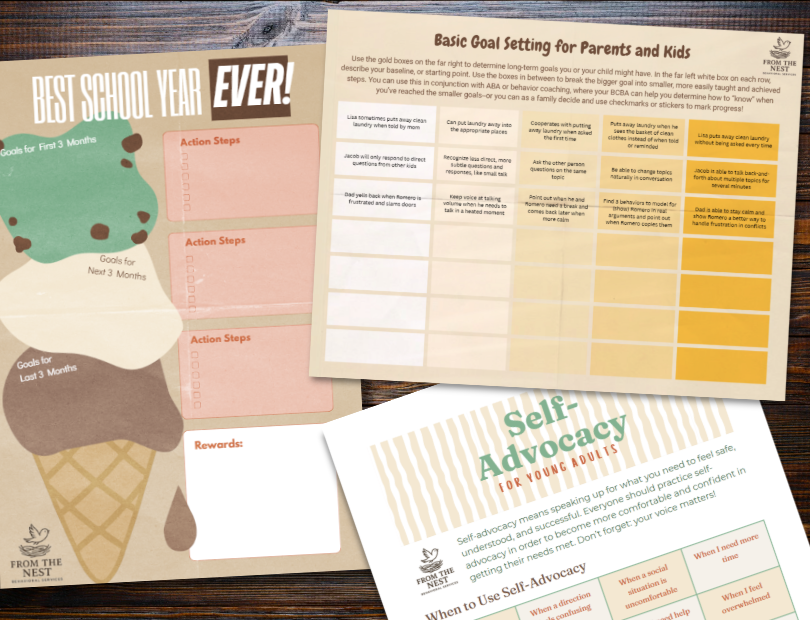
Look at our FREE Printable Resources page for routine visual supports, checklists, goal-setting worksheets, teen and young adult guides to jobs and self-advocacy, and more!