
The Truth About Attention-Seeking Behaviors
“He’s just doing it for attention.”
It gets scoffed in classrooms, IEP meeting, family dinners, outings with friends, phone calls…even ABA sessions. It’s one of the most common (and most misunderstood) phrases BCBAs hear.
Sometimes, it’s said out of frustration. Sometimes, it’s true. But most of the time, it’s an oversimplification that leads to ineffective or even harmful responses.
In Behavior Terms
In ABA, behavior is understood in terms of function, or what the behavior does for the person, which I cover in my post “Function Junction, What’s Your…Function?” (12 November 2025). We may say a behavior, or what someone is doing or has done, is “attention-maintained,” or that the behavior is more likely to occur because it reliably produces attention from others.
That’s it.
It doesn’t mean the learner is manipulative or trying to be difficult or “just want attention” in a vague or intentional sense. It simply means that attention is reinforcing that behavior.
So why does attention maintain the behavior?
Attention is not optional. It’s a core part of how humans learn and communicate and build relationships. For many children, especially those with communication delays or social challenges, even unwanted or unsafe behaviors can become the most efficient way to get attention. If yelling, hitting, or interrupting consistently results in someone talking to them, looking at them, producing a stimulatingly big reaction, giving them the item they want, soothing and reassuring them…the behavior is doing its exact job and serving its exact purpose.
Planned Ignoring…Or…?
The most common response to “attention-seeking” behavior is, “Ignore it.” When I was an RBT, “planned ignoring” was the go-to response to attention-seeking. If you wouldn’t reinforce an access-seeking tantrum by giving the child the toy they’re screaming and crying over, you don’t reinforce an attention-seeking tantrum by giving the child attention, including talking to, hugging, or even looking at the child.
Sometimes, planned ignoring is appropriate. But here’s where it often breaks down:
The behavior is the only reliable way the child gets attention.
If appropriate skills, like knowing how to politely interrupt when needed, how to wait for someone’s attention, when welcome to join a group, how to start conversations, identifying and accessing other stimulation, and much, much more are not yet taught, not reinforced, or not as effective, then removing attention without teaching an alternative can escalate behavior.
Attention is still happening…just not in a helpful way.
Eye contact, talking, reacting, even visible frustration can still function as attention. So you end up with inconsistent responding and intermittent reinforcement
Which is actually very effective at maintaining behavior long-term.
We miss the bigger picture and what might actually be effective.
Not all behavior labeled “attention-seeking” is purely about attention. It can overlap with the other functions as well:
- Escape (getting out of demands; low tolerance for delays or denials)
- Access to tangibles
If we assume “attention” without assessing, we risk targeting the wrong function.
So, if a behavior is maintained by attention, the goal isn’t to eliminate attention. It’s to change how attention is accessed.
That usually involves the following:
Teaching Alternative Behaviors
While I’ve listed some above as well as part of appropriate attention-seeking behaviors, more simple examples for easier conceptualizing include:
- Requesting attention appropriately using communication systems (verbal, AAC, gestures)
- “Look at me”
- “Excuse me”
- Raising hand
- Waiting for attention
- When asked/told
- Recognizing on their own when it’s not their turn, talking would be interrupting, etc.
Don’t Forget to Reinforce
These need to be explicitly taught, practiced, and reinforced consistently. If appropriate behavior works faster, works more reliably, and gets better quality attention, it will start to replace the problem behavior.
But when reinforcement slips too early or you return to giving the desired level of attention to the undesired behavior, you get resurgence, when the metaphorical scale gets tipped in the wrong direction again, and you’ll have to work to build up that skill again.
On a similar note, while reinforcement comes after a behavior, we can provide attention before the behavior occurs to reduce the likelihood of the behavior. For example, if your child tends to poke at the baby to make it cry when the baby is getting more coos and cuddles, giving a lot of one-on-one attention to the older child before diaper changes and breastfeeding may reduce how likely they are to poke.
Watch the Ignoring
As mentioned, ABA has strong roots in planned ignoring. But, as our field’s understanding of how to provide best, most ethical care to our learners, we have found some nuance to this intervention.
First, when used, ignoring should be paired with teaching alternatives. If the unwanted behavior is put on extinction, or no longer result in reinforcement (attention) and thus doesn’t work well enough to keep using, there needs to be another skill that does work well enough to keep using.
Second, a phrase BCBAs and RBTs often use is, “ignore the behavior, not the child.” We never completely remove their access to use, including our support and patience. We don’t ignore potential physical or emotional harm. We don’t pretend they don’t exist, we can’t hear them, or they don’t matter until they comply. So how do you ignore the behavior?
One way is to avoid commenting directly on the behavior. We can direct our guidance toward the learner without rewarding the behavior. Here’s an example:
- Julia is on the phone when her son, Paul, comes in and starts asking whether it’s nuggets or pasta for dinner tonight.
- Julia gestures for Paul to rest his hand on her arm, something she’s taught him is his signal to her he wants a turn.
- Paul raises his voice and moves directly in his mother’s line of sight to distract her, repeating his question.
- Julia again gestures and continues her call.
- Paul rolls his eyes, stops talking, and rests his hand on Julia’s arm.
- Julia doesn’t immediately stop, but quickly pauses, smiles to Paul and says, “Thanks for waiting–pasta.”
Julia could have quickly answered the question and not really disrupted her call–no big deal! But, had Julia immediately paused her call to respond to Paul’s question, there would be no reason for him to not expect immediate attention for similar, most intrusive, more involved interruptions in the future.
If Julia would have ignored Paul entirely, it’s more likely he would have continued and even escalated his interrupting until he gained Julia’s attention. It’s even possible that Paul doesn’t even know how else to gain her attention in those moments, or has no alternative skill easily at his disposal. While other useful skills later may be increasing his ability to wait and teaching him how to identify non-immediate needs and what to do with them, Julia promoted the skill she’s been working on with him–ignoring the interrupting question but not Paul–and rewarded only the behavior she wanted to see.
The First Step
Attention-seeking behavior is not a character flaw, but a learning history. We all have to have ways to attract someone’s attention. Labeling behavior as “attention-seeking” often stops the conversation too early. Better questions are, “What is this behavior accomplishing, and what would be a better way for this child to get the same outcome?”
Once we answer that, we can actually do something–teach something–about it.
by Britt Bolton, BCBA
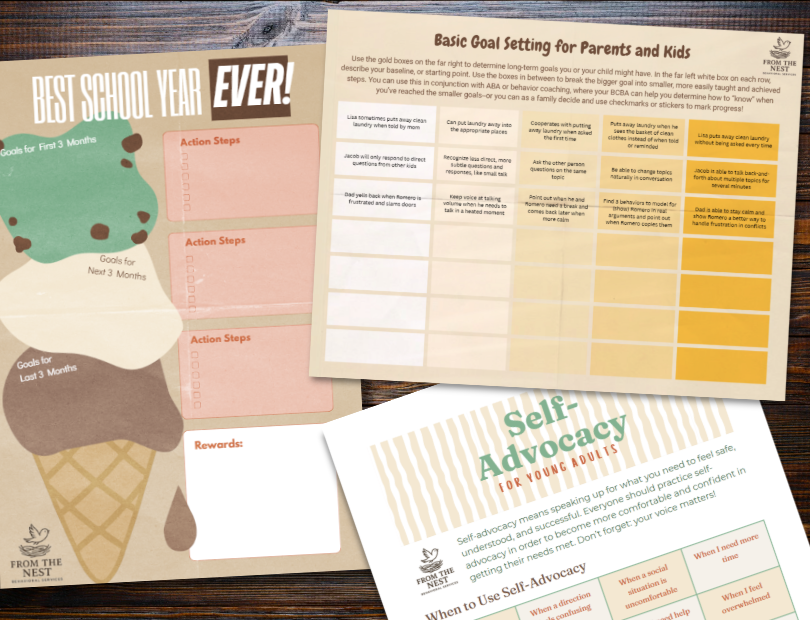
Look at our FREE Printable Resources page for routine visual supports, checklists, goal-setting worksheets, teen and young adult guides to jobs and self-advocacy, and more!