What to Expect in the From the Nest Initial Assessment
Getting started with us
If you’re considering services for your child, you may be wondering what happens before therapy even begins. Do you start treatment right away, and if so, what does it look like? Is there a long series of tests? Will your child be expected to sit at a table and answer questions? How does the clinician know what to target? What if you disagree with recommendations?
For some, you may be starting with us after having received ABA therapy through an insurance-funded provider and know the basics but wonder how private-pay is supposed to work…and if you can even afford it. Our service offerings may seem confusing if you come from somewhere that provided only ABA with a behavior technician or RBT, somewhere center-based, or somewhere that pushed two options: half day or full day therapy.
At From the Nest Behavioral Services, the assessment process is designed to get to know your child as a whole person, not just the challenges that brought your family to us. Every learner has unique strengths, interests, ways of communicating, and goals, and understanding those is just as important as identifying areas where they may need extra support.
Rather than focusing on “passing” or “failing” an evaluation, our assessment is a collaborative process. We’ll spend time talking with you about your child’s history, observing how they learn and interact, identifying what motivates them, and discussing what meaningful progress would look like for your family.
By the end of the assessment, you’ll have a clearer picture of your child’s current skills, practical recommendations tailored to your family’s needs, and a roadmap for how we can work together to help your child thrive.
Before the Assessment
We’ll send needed documentation prior to the appointment. Even without billing insurance, there are consents and other best practices that we follow to ensure consistency, respect, and legal compliance. Included will be a telehealth consent, even if we do not anticipate needing or utilizing telehealth support, and your parent handbook with policies for our families. We may include a Release of Information (ROI) form–common if observation at school or daycare is a needed component of the assessment–that gives us permission to coordinate in any way with other providers, companies, and individuals.
One way From the Nest differs from many traditional ABA providers is our Household Values & Routines Questionnaire. Unlike many intake packets, not only do we collect information on what brought your family to us, but we also learn more about current rules and expectations and start to identify how you are looking for a clinician and therapy to fit into your already-established household. Some families have many strongly held views on a parent and child roles in the family and need a clinician to be open to the rationale behind current expectations and take a more collaborative approach. Other homes have a looser structure or are struggling to find the structure that balances child autonomy with stability and may need a clinician to provide a combination of specific steps, modeling, and direct feedback to feel they are getting on the right track.
Additional paperwork may be requested on an individual basis. While we strive to give parents rationale behind requested documents upfront, we encourage any and all questions during this process. While some documents are required for different reasons in order to receive services, which can be discussed further, refusal to submit a requested form does not inherently bar a client or family from participating with From the Nest.
Parent Interview
While we highly value and prioritize the involvement of learners in identifying therapy goals, no matter their age, we often start the actual assessment appointment with interviewing the parent(s). There are some learners who will respond much better to the assessing BCBA if we start with their direct skill testing (below) first, so your experience may vary slightly depending upon your child’s needs.
Some topics we dive into in this interview are:
- Your child’s strengths
- Your concerns, or what interested you in services
- Daily routines
- Communication
- Play
- Social skills
- Safety skills
- Unsafe behaviors
- Sleep
- Independence in self-care (like toileting) & household activities
- Eating & mealtime skills
- Medical history
- School/daycare reports
- Previous therapies
- Family goals & values
Child Observation & Direct Skill Testing
This part of the assessment may occur as part of the initial meeting or as a separate appointment.
We will observe how your child interacts with you and others, how they respond to the assessing BCBA (a stranger and a neutral party), and other skills and behaviors. We will also interact in ways to discreetly test current skills. We recognize that children often engage different with unknown adults or when someone else is in the room, and we take this into consideration when scoring our assessment tools.
Some of the skills we’re looking for naturally or testing for include:
- Play skills
- Joint attention
- Functional language, like ability to make requests and respond to instructions and questions
- Flexibility
- Emotional regulation
- Motor imitation
- Matching, or 1:1 correspondence
- Social interaction & social preferences
- Daily living skills
Similar to the insurance model, we will complete at least 2 skill assessments that will help to highlight your child’s strongest areas and areas for improvement. Common tools include:
- Vineland-3 (Vineland Adaptive Behavior Scales)
- VB-MAPP (Verbal Behavior Milestones Assessment and Placement Program) Milestones
- VB-MAPP Barriers
- VB-MAPP Transition
- AFLS (Assessment of Functional Living Skills)
- ABLLS-R (Assessment of Basic Language and Learning Skills – Revised)
- Essential For Living (EFL)
- ESDM (Early Start Denver Model)
We may ask for parents’ involvement in completing these assessments.
This is also a great opportunity for us to discover from the learner directly what their goals, values, struggles, and personal motivators are. Quality and ethical therapy is focused on learner involvement, not talking and planning around them.
Another focus of this time is acquiring information via interview, observation, and other data collection on the potentially behaviors of concern. Don’t worry–we don’t trigger your child into an unsafe episode. Instead, we look at:
- Antecedents, or what immediately occurs before the behavior
- Consequences, or what happens immediately following the behavior
- Setting events, or the details surrounding the behavior, like where, when, and with whom
- Possible functions, or what may be motivating the behavior so that we teach safer skills that still help to meet needs
Additional Session(s)
If needed, we may schedule a second or third session, especially if we need to see the child in multiple environments. Common examples of this are a child who is more successful with social skills at home and school than on the soccer field, or a teen who is less organized and independent at mom’s house than at dad’s, or a toddler who is successfully using the toilet at daycare but is reluctant to use the toilet in unfamiliar community bathrooms.
Creating the Treatment Plan
Our assessing BCBA will use the collected information to write the treatment plan. This plan includes a breakdown of our findings, proposed goals (if we’re recommending services through From the Nest), a transition plan (an estimated timeframe, when we’ll determine the learner to be ready for next steps, and what those will look like), and any other recommendations. For learners with potentially unsafe behaviors, we will include a behavior plan that more thoroughly outlines how we will not only respond, but also how we will help to reduce or eliminate the behavior long-term.
Reviewing Recommendations
The assessing BCBA will meet with you to wrap up the initial assessment by reviewing findings and recommendations. At this time, one or more specific service offerings will be recommended based upon your and your child’s goals and our clinical insights. Current service offerings and rates/packages can be found on our homepage, where you can click to learn more about the individual offerings, or on our “Which Service is Right?” page.
While each offering has its own predetermined rate or package deal, your family’s needs are taken into account. For families unable to afford the recommended treatment dosage, a reduced schedule may be possible with potential for a slower rate of skill progress; your assessing BCBA will be able to discuss this further with you based upon your specific needs. A “parent support only” model is often an appropriate “backup recommendation” that many families find to be easier on schedules and budget while maintaining clinical guidance, parent involvement, and ongoing skill-building.
The assessing BCBA will also explain next steps and how we will determine clinical readiness. For example, a learner recommended for Direct Skill Support (BCBA-direct ABA therapy) for 2 hour per week in the home and 2 hours per week in the community might be reduced to only the 2 community hours once he is maintaining 90% independence across communication and appropriate sibling play goals, then reduced to 3 months of only Parent Support to make sure parents have access to professional guidance once he is able to stay with them, tolerate getting into his car seat, and successfully make it through the store checkout without a meltdown for 6 store trips.
Beginning Services or Referring Out
After reviewing recommendations and reaching an agreement on the details of the service(s) From the Nest will be providing your family, we will generate a final approval agreement with these details and the costs associated. We will then schedule our first session and get treatment started!
In some cases, we may determine that From the Nest cannot safely and/or ethically provide the services you or your child would benefit from. In these situations, we do not just send you on your way–we will provide rationale, clear recommendations, and resources, including contacts to reach out to where appropriate. We may also recommend returning for a reassessment at an indicated later date, free of charge, depending upon specific circumstances.
Ready to Get Started? Let’s Chat!
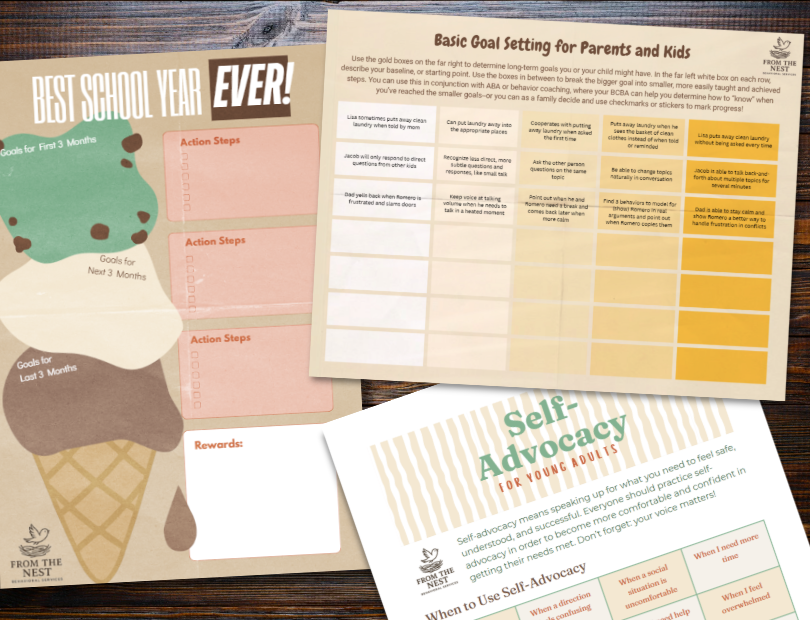
Look at our FREE Printable Resources page for routine visual supports, checklists, goal-setting worksheets, teen and young adult guides to jobs and self-advocacy, and more!