Why Your Child Behaves Better With Others Than You
And What You Can Actually Do About It
You drop your child off at school and brace yourself a little. You know how the morning went: The refusal to get dressed. The meltdown over the wrong cup. The 20-minute negotiation over shoes. But afternoon pick-up arrives, and the teacher says with a big smile, “She had a great day! Listened well, played nicely, no issues.”
Wait… what? That same child? Your child? The one who screams like a kidnapping victim if you peel their banana wrong?
It’s so easy to feel a mix of relief and frustration in these moments. On one hand, at least you don’t have to now deal with teacher complaints, and maybe–just maybe–the evening will go a little smoother following a positive school day. On the other hand, why does it seem sometimes like your child behaves so much better for everyone else?
I’ve worked with many parents who have sighed sadly and reported a similar feeling in intakes, or have expressed that they “must be doing something wrong” in this case. It may come as a relief (or not, which is valid) that I and many other BCBA parents experience the same sometimes, even trying to “practice what we preach”! And there are some interesting reasons for this that don’t necessarily mean what you might think.
A Simplified “Why”
There are several common factors that contribute to children behaving better with others. The short is, your child isn’t “worse” with you…they’re more real with you.
Think about someone–anyone, not necessarily a parent–you have felt safe with. How did you communicate with them? What feelings did you share and how? Did you feel you could express yourself more freely, without potential repercussions, like damaging the relationship?
Children often feel safest with their parents. As a result, they may feel more comfortable expressing big emotions, which may not always come out in the most prosocial ways! This is already a typical developmental stage for neurotypical children, where emotional regulation is still stabilizing, but neurodivergent kids may express themselves in more unsafe or disruptive ways. For children on the autism spectrum, for example, communication challenges, low frustration tolerance with changes and unwanted activities, sensory sensitivities, and challenges in taking another’s perspective, especially in early childhood, big emotions like anger, sadness, annoyance or agitation, disappointment, and overwhelm or anxiety can lead to yelling, throwing items, hurting themselves or others, breaking things, and general opposition. You as the parent have more opportunities to see the real, full range of emotions and behaviors compared to a teacher, doctor, babysitter, or others, who a child may even be able to maintain calm with for a short period.
What many parents don’t hear is, this is actually a good sign. When children fall apart more with you, it often reflects secure attachment, not disrespect. Research in child development consistently shows that children use their primary caregivers as a safe base, meaning they feel most comfortable expressing distress, frustration, and big emotions with the people they trust most.
More simply: your child trusts you enough to lose it. That doesn’t make it easier in the moment, but it does reframe what you’re seeing.
Making Themselves at Home
There’s something to be said for the difference between home and other environments. Being “at home” or “making yourself at home” are commonly understood to mean being comfortable and relaxed. By nature, most homes are lower in structure and expectations than environments like school, therapies, workplaces, and other community settings.
Your child may have other kids around to model, or show, what happens when these rules are followed and the consequences when they’re not. There may also be more motivation to meet expectations outside the home, like attention from others (other kids, favorite adults, quantifiably more people) and access to things they don’t necessarily have at home (playgrounds, different toys, play rooms).
Rules and routines may also be more clear in these environments than at home. This doesn’t mean you’re not holding your child accountable. But it does mean that, understandably, you may be more likely to give into tantrums or say forget it when your instruction isn’t followed when trying to maintain safety for you, the child in question, and anyone else in the home. I’m all for picking your battles on small, inconsequential things. The risk in doing this, however, is that your child may not learn the contingency, or how Behavior A results in Consequence A if it sometimes also leads to Consequences B and C.
The Functions of Behavior
If you’ve read our post on the functions of behavior, “Function Junction, What’s Your…Function?” from November 2025, you already know that all behavior happens for a reason. If your child whines more with you, refuses only your instructions, hits only you…those behaviors are working differently in this environment than others.
To recap, behaviors serves at least one, if not more, of four functions:
- Attention
- Access to Tangibles (items, activities, locations, etc.)
- Escape/Avoidance
- Automatic (things like sensory stimulation)
If you’re seeing behaviors with you and no one else, or they are more frequent, longer lasting, or more severe with you than anyone else, it may be because*:
- They get faster or more attention from you (yes, even when you yell–that’s attention)
- You’re more likely to give them what they want for screaming, hitting, etc.
- Their tolerance for things they don’t want to do is gone by the time they get to you after school
- You might give them squeezes, kisses, hugs, and other affection if they seem dysregulated
*By no means is an exhaustive list.
Not “You’re the Problem;” You’re the Solution
This doesn’t mean you are failing, are at fault, are being blamed unfairly, or should necessarily change what you are doing. But ABA looks at the environment, including others in it, to determine how the things before the behavior (antecedent) and the things after the behavior (consequence) impact how often, how badly, and in what situations the behavior occurs. In other words, the pattern is extremely relevant and will impact how we teach skills to get more consistent safe behaviors across people and situations. Often, that means changing how the environment (and caregivers) are set up and how we’re responding.
Some common things we will work on is increasing consistency in how we respond. Remember how I said above that kids can get confused about the contingency? We want to teach that Behavior A leads to Consequence A, not Consequence B or C. Similarly, Behavior B can’t get to Consequence A. Let’s make this a little less abstract. If Wayne starts throwing anything he can grab when waiting for his mom to get his snack, and he is used to this sometimes being effective in motivating mom to move faster in getting that snack, it doesn’t matter that it isn’t always effective–it might still be worth trying if it works sometimes. Instead, we want to teach that throwing things is never going to get the snack faster (or maybe at all), whereas taking a seat at the table to wait will consistently cue mom to go get the snack.
We often try to find antecedent strategies, or what we can use to reduce the chance of the unwanted behavior before it has the chance to happen. One we might build in is giving really clear expectations ahead of time. In the Wayne example above, if we know he’ll ask for a snack after school and start throwing things soon after asking if mom doesn’t get up quickly, we might remind him on the way home, “Remember, I might be busy when you’re ready for snack. I need you to wait at the table, and I will get it to you as soon as I have a chance to. If I seem to forget, you can ask again 1 time to remind me.” Another antecedent strategy we might try is building in more structured routines. If, for example, Wayne already knows he will be offered a snack as soon as he gets home, the motivation to throw things will disappear.
The Goal of ABA Intervention
The goal in ABA is never to take away the security your child feels with you or to introduce values, structures, or other components into the home you disagree with. The goals instead are to understand the behavior, understand why it appears differently at home or with you than with others, and teach replacement behaviors.
You’re not seeing the worst version of your child. And you’re not failing them. With the right supports, structure, and skills, you and the ABA treatment team can work together to build a home that is safe and regulating for everyone.
by Britt Bolton, founder & clinical director (BCBA)
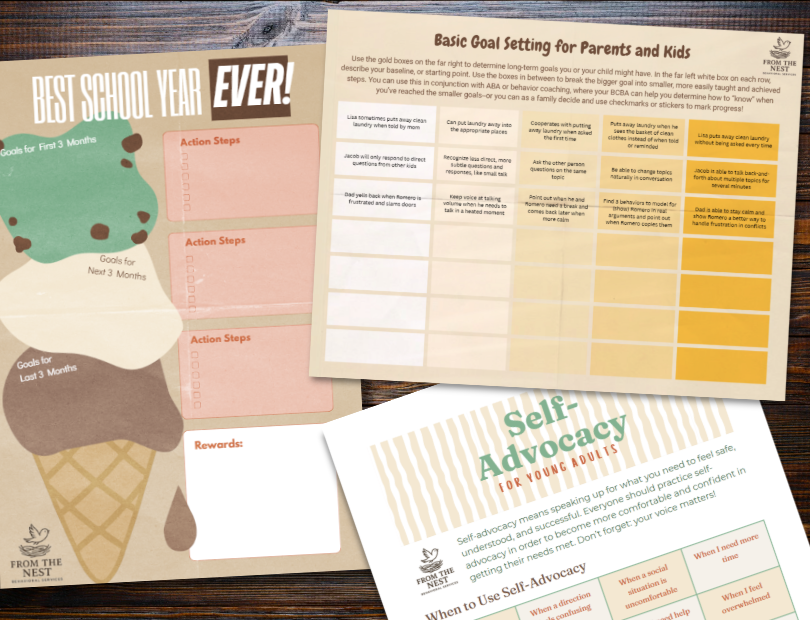
Look at our FREE Printable Resources page for routine visual supports, checklists, goal-setting worksheets, teen and young adult guides to jobs and self-advocacy, and more!