
Helping Your Child Play Independently (Instead of Following You Around)
One of the most common concerns I hear from parents, especially of kids on the autism spectrum, very young kids, or singleton children (the “only child”), is that their child just won’t get out from under their feet. Sometimes, it is nice and even necessary to tell your child to “just go play.” Many parents turn to screens to occupy their child when needed, which comes with its own challenges.
It makes sense. Independent play isn’t something all kids naturally “just do.” It’s a skill. And like any other skill, it can be taught.
Functions, Again
Before jumping into strategies, it helps to understand what’s going on underneath the behavior. You may already be familiar with functions from reading our November 2025 post, “Function Junction, What’s Your…Function?” where we covered the four functions of behavior, including attention.
When a child constantly seeks your attention, it’s usually not because they’re being “clingy” or manipulative. More often, it’s because:
- They don’t know what to do on their own
- Even if they have a room full of toys! If your child struggles to recognize what items are used for, to attend to (watch) what others do, and to imitate others, they might look at many of their toys and either fiddle with them for a minute or outright walk away.
- Play doesn’t feel rewarding yet
- They’re used to interaction being the most engaging option
- Does your child show a strong preference for tickles, hugs, squeezes, rubs, smiles, praise? Toys may just inadequately complete with human interaction.
- They may have difficulty initiating or sustaining activities
For many autistic children, play doesn’t come intuitively. Skills like imagination, sequencing, flexibility, and persistence can all impact their ability to play independently.
So when they follow you around? They’re choosing the option that works. All behavior is communication, and shunning independent playtime with toys to stick closely to you is communicating that you meet a need those toys just don’t, or at least not yet.
Let’s break this down into a step-by-step guide to moving from total dependence to independence.
Step 1: Define What “Independent Play” Actually Means
A common mistake is expecting too much, too soon.
Independent play doesn’t have to mean 30 minutes alone or complex pretend play or a complete absence of interruptions.
Instead, start smaller:
- Playing with a toy for 1–2 minutes without help
- Staying engaged in an activity while you sit nearby
- Completing a simple, familiar routine independently
Sometimes, even a small step in independence can surprise a parent with how big it feels. You may go in feeling like you need them to play alone in their play room for 20 minutes so you can have uninterrupted time to scroll social media before making dinner in order for you to be your best, most calm and regulated self. But when you start having multiple 5-minute chunks per day, you might already start to feel some relief in addition to the excitement of seeing your child develop.
For your child, based on what he or she can currently tolerate or do, what is the smallest possible step? Build from there.
Step 2: Start With Activities They Already Like
If a child doesn’t enjoy an activity, they’re not going to stick with it independently. Don’t focus on what your child “should” be doing or playing with at their age. Instead, look for what they already gravitate toward and ask yourself, “How can I make this easier to do alone?”
Some ideas:
- Repetitive or sensory-based toys (spinning, stacking, sorting)
- Keep non-messy ones, like pop tubes and fidget spinners, low and easily accessed
- Consider a clear container clearly visible on a shelf with a picture label for messier sets, like kinetic sand and small Legos, so your child can indicate interest but you get them down and set up for them
- For the adventurous parent, try non-toxic messy materials, like a handful of cooked spaghetti, pudding/yogurt, edible dough (recipes can be found online), or gelatin on a plastic tarp or mat, out in the yard while you are nearby, or in an empty, clean bath tub. Note that a child should never be left unsupervised in a bath of water for any duration and, even without water, should be checked on periodically for safety.
- Cause-and-effect toys
- Lay out a variety of sound-making, light-up, and pop-up toys–even better if on the floor in 2 or 3 different rooms
- Puzzles or matching tasks
- Pre-set, or spread out, the puzzle instead of keeping pieces in the box
- Consider putting together a “busy folder” (printable templates often free or low cost online), where your child has materials that can be matched and Velcro’d together for a low-mess activity.
- Favorite characters or themes
- Find any of the above themed around their favorite show
- Check out Pinterest for ideas of activities you may even be able to put together in a different theme
- Print coloring pages or find a coloring book in that theme. Kids don’t have to use crayons–you can try markers, finger paints, bingo daubers, colored pencils, or other materials.
But Britt, you might say, my child doesn’t actually like any toys or play activities. That actually brings us to our next step.
Step 3: Teach the Skill (Don’t Just Expect It)
Independent play is often treated like something kids should figure out on their own. But many children, especially those with autism, need it broken down and taught.
We start with supported play, then gradually step back. Play together, modeling how to engage with items without expectation. If, per the above, your child doesn’t typically appear interested in anything, this may help to increase their interest–just pick a toy or activity and go! Then, once your child is engaging with the same items, let them take the lead while you start to do more watching and commenting, going more hands-off and giving fewer suggestions or directives. If at this stage your child starts really trying to get you involved again, repeat these phases but be sure to start to try to fade back again once they are more independent.
Once they are still playing with you sitting and engaging, very slowly start to reduce how much you are engaging. If you can busy yourself with something else while staying in the space, this is your opportunity, and it is likely they will continue to play without you for a period of time. If they try to get your involvement again, you might try to encourage them to continue while you watch, followed by again disengaging once they stop paying attention to you.
Otherwise, at this phase, you may be able to trial briefly stepping away and returning. Start to increase your time away by a few seconds to up to 1 additional minute at a time. Try to stay in an adjacent room, not completely across the house, up- or downstairs, or outside. You might even try the “I’ll be right back” approach: contrive an opportunity to run a very quick errand to another area, just out of sight, and return. This can help to reassure your child–just be sure to actually come right back!
This is essentially scaffolding, or fading your support over time.
Step 4: Reinforce Independent Play
If independent play isn’t naturally rewarding yet, we need to make it more worth their while.
That might look like giving specific praise, like, “You kept playing all by yourself! Way to go!”
You could join them again in play as a reward for doing well solo. For example, if you’re able to spend 10 minutes away, you might come back and offer to join the activity for 10 minutes together.
You might even consider something really motivating, like a favorite snack, favorite candy, helping with a preferred household task if they have one (making dinner, grocery shopping, sorting laundry, vacuuming), or a new toy to add to their set (and give you the advantage of an exciting new distraction!) to motivate continued progress.
The goal is to build a positive association: “Playing on my own = good things happen.”
Step 5: Don’t Accidentally Reinforce Constant Attention!
This is the part that’s hard but important. If you roll with it every time your child whines, follows you, interrupts, or pulls or pushes you from what you’re doing to something they want, you teach them that what they are doing works at getting or keeping your attention.
Instead:
- Give attention before they escalate (proactively)
- Reinforce independent moments
- Be mindful about when you respond and how
This isn’t about ignoring your child. It can feel like that sometimes! But it is about being intentional. It may feel helpful to your child in the moment to immediately jump up as soon as they want you or something in the environment, but in the long run, it’s not teaching valuable skills or setting up their expectations to match the “real world.”
Step 6: Build Play Into Routines
Independent play gets easier when it’s predictable. Consider building intentional independent play opportunities into the day. For example, “After snack, it’s playtime” or “We can play together for a few minutes, but at 5:00, Daddy goes in to make dinner.”
Structure reduces the mental load of figuring out what to do (for both the parent and the child!).
Pulling It All Together
If your child currently can’t play alone at all, jumping to “go play for 30 minutes” isn’t realistic. Progress might look like 10 seconds on Day 1 while mom sits nearby, then 1 minute on Day 10 while mom is across the same room, then 12 minutes on Day 30 while mom has enough time to schedule a doctor’s appointment uninterrupted. And that counts.
If your child struggles to engage with toys at all, has very limited play skills, and/or becomes highly distressed when you step away–or you’ve been consistently applying all the steps above with no progress–it may be helpful to work with a professional (like an occupational therapist or BCBA) who can break the skill down and build a plan tailored to your child.
Independent play isn’t about pushing your child away. It’s about giving them the skills to explore their environment, build confidence, and enjoy their own world.
And yes…have a moment where you can drink your coffee while it’s still hot.
by Britt Bolton, founder & clinical director (BCBA)
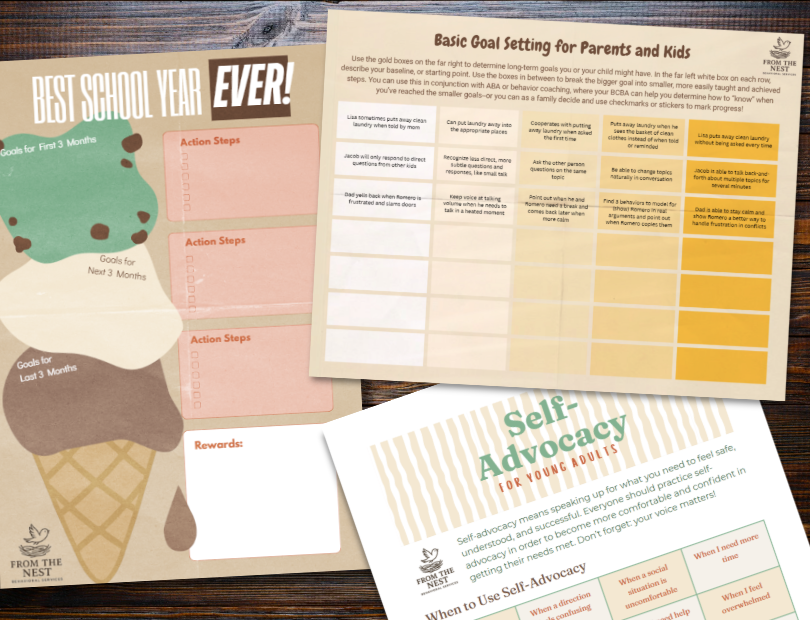
Look at our FREE Printable Resources page for routine visual supports, checklists, goal-setting worksheets, teen and young adult guides to jobs and self-advocacy, and more!