Not Covered: What Insurance Won’t Pay For in ABA (and Why)
“We can’t work on that. Insurance won’t approve it.”
When you hear that from your child’s BCBA, it doesn’t seem to make sense. Your child doesn’t quickly pick up on some things, like thoroughly brushing his teeth every time, adding two-digit numbers, making his own sandwich, or using calming strategies, like mindfulness. You’ve heard teachers and doctors say he “should” be doing those things by now. He has an autism diagnosis, and he was referred to ABA, what’s been called the “gold standard” autism treatment. So what does that even mean? Why wouldn’t insurance approve the skills he actually needs?
This is one of the most confusing (and frustrating) parts of ABA services for families. Honestly, it can be confusing and frustrating for us clinicians too.
So what’s covered, what’s not, why does that make sense, and what are any of us supposed to do about it?
Is That Medically Necessary?
Whether commercial insurance or Medicaid, coverage for ABA is based on medical necessity, not just what would be helpful in day-to-day life. That means services are often not covered if they fall outside strict clinical definitions.
In general, insurance may not cover:
- Skills that are not clearly tied to a behavioral or developmental deficit
- Caregiving tasks (like bathing, feeding, or toileting as care)
- Goals that are not measurable or behavior-based
- Services considered educational or academic rather than medical
- Parent support or training (in some states and plans)
Coverage isn’t about what would help, even though we know that ABA as a science can be applied “all over the place.” It’s about what meets specific, documentable medical criteria.
Medical necessity for autism spectrum disorder (ASD) means that our ABA goals tie directly to the diagnostic criteria for autism, which you can find in our November 2025 post on the same topic. In states like Colorado where Medicaid covers non-autism medical necessity, this would look like a pediatrician referring to ABA to address specific characteristics of that learner’s diagnosis or diagnoses as well.
Here’s where things start to feel disconnected. From a parent perspective, the goal is often simple and, for them, obviously tied to the diagnosis: “I want my child to function better in everyday life and, because they have [insert challenges here], clearly the goal is needed and ABA is the treatment.”
But from an insurance perspective, the goal is, “This service must treat a diagnosable condition using measurable, evidence-based methods. Even if you see [same challenge as above], if any interpretation of how that challenge is a result of the diagnosis is needed, we can’t say for certain ABA is necessary over anything else.”
For example:
- Teaching a child to request the bathroom is often covered because of the communication challenges of autism, like failure to initiate an interaction, including by asking something, BUT
- Providing hands-on toileting care, like diaper changes or wiping on the toilet, is often not covered (though might need to be part of a school- or center-based model because parents aren’t present), as 1.) a non-ABA-trained professional is not necessarily needed to provide that care and 2.) teaching of a new skill is not automatically a part of doing something for someone.
Typical Pushback
While every state and plan is a little different, and it’s important to know that this article is not an exhaustive list. Your child’s insurance may be even more restrictive or might accept goals that seem like they wouldn’t be covered. But there are some common patterns in what gets denied or flagged:
Goals That Sound Like Caregiving
If something looks like supervision, childcare, or general daily care, it’s likely to be denied.
What do we do, then, if something related to this comes up, like a child needs her diaper changed? At From the Nest and many home-based ABA companies, we take a firm stance that personal care tasks that involve privacy and bodily autonomy, like diapering/toileting, bathing, and dressing, should be completed by the parent, in part to avoid the unintended role expansion or boundary blurring that could lead to Medicaid pushback, but also to promote safety, dignity, and consent.
What if your child struggles with these tasks? We can provide coaching, model techniques, put into place clear guidelines backed by research (evidence), and collaborate with you to teach and support without taking the tasks entirely over.
Vague or Non-Measurable Goals
Insurance wants clear definitions, observable behaviors, and trackable progress. Without these three components, no one can truly be confident that ABA has been effective or that the learner has mastered the skill.
“Improve behavior at home” won’t pass. “Will independently request help using a 2-word phrase in 80% of opportunities” will.
Language That Doesn’t Fit ABA Or Is Outside Scope
Even if something would genuinely help your child, insurance may deny it if it’s considered:
- educational
- recreational
- general parenting support
- better treated by another service, like occupational, physical, or speech therapies
- a mental health or mentalistic service (like mindfulness or anything resembling Cognitive Behavior Therapy [CBT], play therapy, family counseling, etc.)
If you’re a provider yourself, you may notice that things we sometimes work on, like communication, emotion recognition, mindfulness in ACT or the AIM curriculum, motor imitation, and any school-based or group goals seem to overlap with some of the above. You might have similarly run into a partial or full denial of services by a payer due to your goal(s) being considered “not real ABA,” even if you were trained/certified in what was being used, you were using ABA techniques to teach, and you tied the goal to the function of the behavior and/or medical necessity. I, for one, faced a denial when I attempted to gain approval to provide chewy or crunchy consumables or a chewy sensory toy as a functional replacement for mouthing dangerous materials, as the payer considered this part of a sensory diet and outside ABA scope, even though the skill was functionally equivalent.
The Times They Are A-Changin’
Lack of coverage can be very frustrating, but it makes sense that payers would be hesitant to cover anything they don’t “have to.” There’s been increasing public attention on ABA services, including coverage and oversight, with broader conversations appearing in outlets like The Wall Street Journal. Take, for instance, recent articles like “The Boom in Autism Therapy Is Medicaid’s Fastest-Growing Jackpot,” “Autism-Therapy Firm That Was Paid $340,000 per Patient Is Barred From Medicaid,” and “Five Takeaways From the WSJ Investigation of the Autism Therapy Business,” which just this month dove into the billing practices of a particular Indiana provider that earned approximately $29 million for just over 80 learners in 2023. At up to 40 hours per week per learner, ABA is a very expensive treatment, with such companies not earning us many friends in the insurance space!
Across multiple states, Medicaid programs are beginning to tighten definitions of medical necessity, increase scrutiny of treatment plans, and limit what qualifies for reimbursement. What this means for families is that services may become more narrowly defined. Providers may have less flexibility in what they can target, and communication and clarity will matter more than ever.
What the ABA Team (Parents Included) Can Do
This system can feel frustrating but there are ways to navigate it effectively.
Parents should ask how goals are being written to ensure approval and consistent coverage across authorization periods if extensive teaching is needed. For practitioners, we should explain our scope early on in the goal-planning phase with parents, as well as how our initial priorities tie directly to the diagnosis.
Even if a specific task isn’t covered, related skills often are. This isn’t being sneaky or trying to mislead the payer: this is being clear on the provider and parent end of what specifically we can do to help the learner, as well as where other professionals may need to be tagged in. For example, a teenaged learner building independence may need not only ABA, but also a vocational rehab or other early job readiness service, mental health services to address hormonal emotional changes, occupational therapy to build individual ability to physically complete personal and domestic tasks, and a tutor to help with independent study skills. As for ABA’s role, we might focus more on functional replacement skills, like self-advocating for alone time instead of slamming the doors and screaming when overwhelmed, as well as evidential practices for safe ways to gain others’ attention when we want to have a conversation.
For You & Your Child
When something is “not covered,” it doesn’t necessarily mean it’s not important or it wouldn’t help your child. Instead, it usually means it doesn’t meet insurance’s definition of medical necessity. Understanding that distinction can make ABA services feel a lot less confusing and help you advocate more effectively for your child.
Here’s a quick recap:
Typically Covered:
- Direct therapy (skill acquisition, behavior reduction)
- Supervision and program updates
- Assessments
Often NOT Covered:
- Caregiving tasks
- Non-measurable goals
- Non-ABA language
- Services outside medical necessity
The rule: If it’s not measurable and medically necessary, it’s probably not covered. If you’re ever unsure whether something should be part of your child’s program, ask. The right provider will help you understand not just what is happening but why.
by Britt Bolton, founder & clinical director
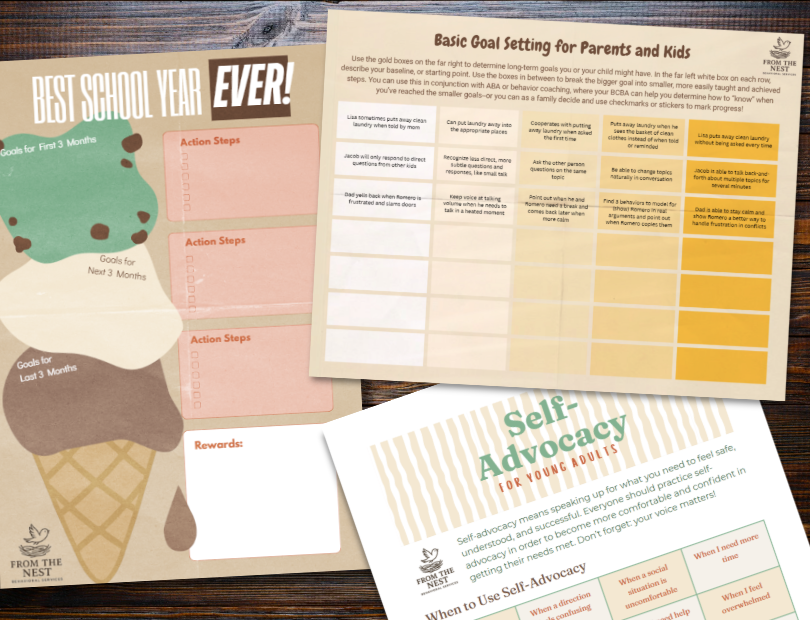
Look at our FREE Printable Resources page for routine visual supports, checklists, goal-setting worksheets, teen and young adult guides to jobs and self-advocacy, and more!