
What to Do When Your Child Doesn’t Listen (Without Yelling, Punishing, or Bribing)
I’ve had multiple parents say something to me along the lines of, “Wow! With what you do for work, I bet your kids are perfectly behaved.” Ha–you would think! But seriously, every child has their moments, and every parent hits that wall of, “This kid just is not listening to me!” It’s natural to feel overwhelmed, frustrated, and even guilty. You notice you’re starting to repeat yourself. Then you’re raising your voice. You might use the same discipline methods you learned from your parents or grandparents. You might try things you find on social media or are suggested to you by your friends. You might even lose it–start yelling, threatening punishment, and bribing them to do as they’re told.
But you can get cooperation without those tools. Listening is a skill kids develop, grown through reinforcement of desired behaviors. No, I don’t mean throw a bunch of reward items and candy at them. I mean showing them that the key to getting what they want is in earning it.
Setting Events: The Stage is Set
When a child isn’t listening, parents often jump straight to discipline. It makes sense. First of all, many of us value respect as a key part of our family dynamics and expectations for our children, and listening–and responding in a timely fashion–is a huge part of that. Second, a child not listening triggers our own responses (and, let’s face it–higher blood pressure) in a way where we react emotionally. We take not listening personally. But much of the time, there are setting events that we’re overlooking. Setting events are the things that sort of “set the stage” for behaviors to occur. These can include:
- Needs: Hungry, Thirsty, Sleepy, Poor sleep, Sore, Itchy, In pain, Uncomfortable
- Distractions, Noise, Crowds
- Changes: Routines, Who’s in the home, Things were moved, Expectations changed
- Bad mood or general irritability
If you think about it, we’re all impacted by setting events. You might be more snippy in a work email before you’ve had your morning coffee. You might be more likely to be ready and out the door on time if you’ve slept better the night before than you usually do. You might be more willing to help your partner with a chore if your movie is over than while it is still on. And if that’s true for adults, who are supposed to be better regulated, imagine the struggle for a developing human doing their best with the regulation skills they have!
A quick internal check can help:
- Are they dysregulated?
- Are they immersed in play?
- Is this a transition?
- Am I trying to talk from across the room?
- Where are we in the routine? Is there something they need?
Once you know what may be causing the “dropped call,” so to speak, you can help resolve those issues and reattempt the instruction.
Even if they seem to not be listening, try to label the situation as a means of starting to teach them the contingency: “Let’s pause for a minute. Your body seems busy right now. Let’s take a breath together and then we’ll figure out shoes.”
This is not “getting out of” the instruction; this is regulating so the instruction can be better received. You are setting up the ideal listening situation.
Connect, Then Direct
This one strategy alone can transform your whole home dynamic. Kids listen so much better when:
- You’re at eye level
- Your voice is calm
- Your presence feels safe
- They feel seen
In fact, take a look at our recent post on co-regulation to learn more about how modeling the desired behaviors–calmness, neutral tone, and self-compassion–along with setting and following through with clear expectations can massively improve listening skills, both in the moment and moving forward.
Yelling is usually a sign you’ve been trying to get cooperation from distance. Positioning can be increase connection before providing direction or correction. Try:
- Walking over instead of shouting across the room
- Kneeling or sitting to match their height
- Gently touching their shoulder if they’re receptive
- Starting with connection:
- “Hey love, I need your attention for a sec.”
- “One two three, eyes on me” (though it should be accepted if the child turns to you or looks toward you rather than forcing eye contact)
It’s like the boss who yells, paces frantically, and is always beet red versus the boss who is controlled, confident, and quietly commands respect just by stepping in the room. You’re looking for authoritative–not authoritarian.
I’ve had many, many parents and school faculty scoff at that idea. In their minds, a child who can’t respond immediately, regardless of the situation, is a problem. For some adults, the child who can’t do that is in inherent danger. And in a way, they’re right. My goal as a BCBA–and as a parent–is not to teach a child to only respond in 100% ideal conditions. But if we’re working on this skill–if we are teaching, not at a point of mastery and trying to generalize and maintain–then setting things up to promote success is the best procedure. Most people would not toss a child into the ocean and expect them to swim themselves to safety. Instead, they would start in a somewhat shallow pool, use floaties, walk them through the steps and dangers, and praise even little progresses. That’s exactly what we want to do here so that they are safe and successful in the non-ideal situations.
Get to the Point
Kids tune out long speeches. Shoot–many grownups tune out long speeches. Kids do best with:
- Step-by-step directions–ideally, stick to just one step
- Clear, specific language
- Instructions instead of lectures
Here’s how we can adjust common instructions to be more clear and concise:
| Instead of This | Do This |
| “Can you please stop making a mess and get ready? We’re running late!” | “Shoes on first.” |
| “Be good while we’re in the store.” | “Stay beside me. Ask before touching things.” |
| “Stop goofing off! If you don’t knock it off, you’re going to your room. I said knock it off!” | “Homework needs done before play time.” |
| “Get along with your sister!” | “Stay in your space and keep your hands to yourself.” |
| “I told you to take the trash out. Why is it still here? How many times do I have to tell you?” | “Pause your game. Trash out first.” |
Be sure that you stick to the expectations you give–if you say homework before play, be ready to calmly redirect back to homework as soon as they get off task, or to offer breaks and immediately return back to homework after.
When possible, offer choices, including between tasks that both need done but the order doesn’t matter (“Do you want to do math first or your reading for tonight?”). This is another form of getting to the point. The choice structure shows that there is predictability, structure, and expectations. We’re not leaving everything up to negotiation, we’re subtly directing the scene. Meanwhile, your child will feel like their preferences matter and that you both are playing for the same team instead of in a power struggle. Win-win!
Gamify
When in doubt, make it a game. Not only can it get kiddo buy-in and cooperation, but it’s hard to be in a funky mood as the adult when you’re finding ways to make it fun!
Some kids like to earn points. These points often should be tied to an actual reward (see the example token economy in our free printable resources), but some younger kids in particular just like to see how many points they can stack. Points systems also help remind us as the parents to reward and call out the positive behaviors we see.
You can also make up silly instructions on the spot that still get the mission accomplished. For example:
- “First one with shoes on and touching the door wins!”
- “Let’s tiptoe like sneaky cats to the car.”
- “The toy dragon says it’s clean-up time.”
- “The hamper’s hungry–we gotta feed him our dirty clothes!”
Just a Sample
This is just a sample of some of the best ways to build up cooperation in kids. Try some of the above and see what happens. You may find some approaches work more quickly than others or that you can add your own spin. For example, between my two children, they consistently respond to very different approaches, and that is okay! On my end as their parent, I have to be willing to adjust how I teach and support them rather than expect them to be more regulated or having stronger social skills than I do after several decades.
If you’re doing your part and your child still consistently struggles to listen, it may be worth exploring a formal diagnosis. Starting a conversation with your pediatrician and having your child evaluated for diagnoses like ADHD, sensory processing differences, autism, anxiety, and language delays can provide more specialized information on how to develop your child’s skills. It can be scary but there’s no shame, only better identifying what tools can make the most difference.
You may find this post on developmental milestones or this post on autism diagnostic criteria to be helpful.
by Britt Bolton, owner/lead BCBA
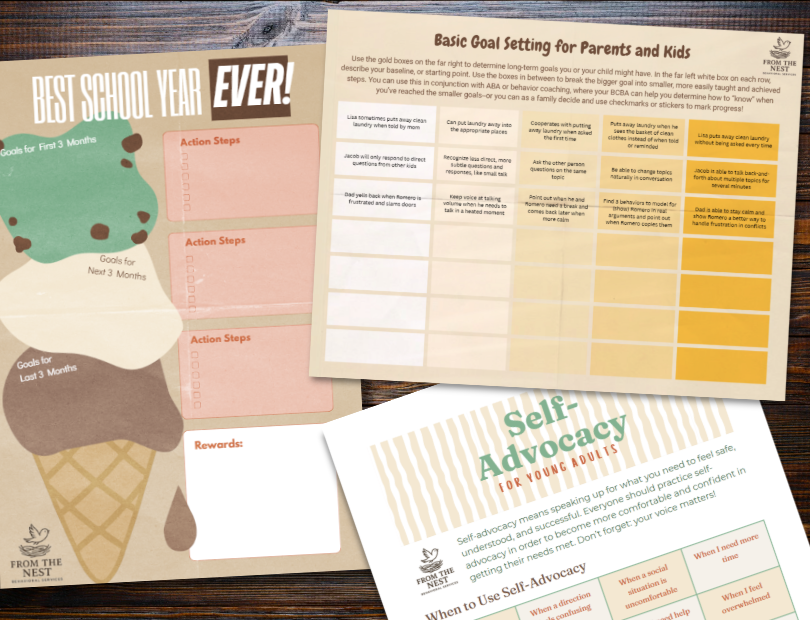
Look at our FREE Printable Resources page for routine visual supports, checklists, goal-setting worksheets, teen and young adult guides to jobs and self-advocacy, and more!